- Talent Edge Weekly
- Posts
- Talent Edge Weekly - Issue 332 - Best of January 2026
Talent Edge Weekly - Issue 332 - Best of January 2026
The top 15 articles and resources from the January issues of Talent Edge Weekly.

Brian Heger
February 01, 2026

SPONSORED BY

Welcome to this special Best of January issue of Talent Edge Weekly!
A shout-out to Laura Nardi, Sr. Manager of Global Talent Management at Delta Air Lines, for referring new subscribers to Talent Edge Weekly. Thank you, Laura, for your support of this newsletter!
🗞️ Not subscribed to Talent Edge Weekly? Subscribe now and immediately get 5 of my PDF cheat sheets!
PRESENTED BY 365Talents
A Docebo Company
2026 marks a turning point for skills, job readiness, and workforce strategy. The question isn’t whether skills will disrupt how organizations plan their workforce, but whether leaders are ready.
Roles are evolving faster than job frameworks, skills are expiring sooner than expected, and static HR models are struggling to keep up.
The 2026 Skills Impact Report cuts through the noise with a clear roadmap for tackling what’s ahead and fully harnessing the power of skills.
Want to get your brand, product, or service in front of our active 55,000+ Talent Edge Weekly subscribers? Learn how to become a sponsor.
THIS MONTH’S CONTENT
This Best of January issue includes the 15 most popular resources from the January issues of Talent Edge Weekly. They span three areas:
I. Future of Work, AI, and Strategy. Brings together research and tools that help leaders anticipate how AI and broader talent trends may reshape jobs and work while strengthening talent planning under uncertainty through scenario planning.
II. Talent Practices. Resources to help practitioners act on core talent practices by assessing whether ways of working and wellbeing practices support performance goals, enabling timely talent decisions, strengthening succession and development pipelines, improving internal mobility, and applying skills-based approaches.
III. Chief HR Officer. Addresses topics such as how the CEO–CHRO pay ratio signals CHRO influence, and what boards value most when evaluating CEO candidates—providing insights for Chief HR Officers on how to support the process.
This issue has many bonus resources, including information about company layoffs as well as movement in and out of the Chief HR Officer role.
Because this is a Best of the Month issue, you’ll find more content than usual—curated to give you options depending on your current priorities. You can scan and focus on what’s most relevant to you right now.
Let’s dive in. ⬇️

Brian Heger
THIS MONTH’S EDGE
I. FUTURE OF WORK, AI, & STRATEGY
Brings together research and tools that help leaders anticipate how AI and broader talent trends may reshape jobs and work while strengthening talent planning under uncertainty through scenario planning.

FUTURE OF WORK SCENARIOS
A 20-page white paper explores how AI advancements and talent trends could lead to four distinct future-of-work scenarios, with insights and actions recommended for each.

Over the past year, I’ve written several posts on scenario planning as a critical tool for envisioning possible business futures and informing talent strategies. Building on those resources, this new 20-page paper explores how AI advancements and talent trends, and their potential trajectories through 2030, could reshape the future of jobs. It outlines four future-of-jobs scenarios informed by two dimensions: 1) AI advancement: the pace and scale of progress in the capability and autonomy of AI technologies, and 2) Workforce Readiness: the availability of skills that prepare workers for an AI-driven economy. Together, these make up four distinct scenarios: 1) Supercharged Progress, 2) The Age of Displacement, 3) Co-Pilot Economy, and 4) Stalled Progress. While you’ll need to read the report to gain the full context for each scenario, one example is Supercharged Progress: AI advances at an extraordinary pace, reshaping industries, business models, and workflows as productivity and innovation accelerate through widespread adoption of advanced, agentic AI. While many jobs disappear, broad workforce readiness enables new roles to emerge and scale quickly, with humans increasingly orchestrating intelligent systems as governance, ethics, and social safety nets struggle to keep pace. Regardless of the scenario, page 16 provides nine “no regrets” moves, such as starting small, building fast, and scaling what works, that can help organizations prepare for multiple scenarios.

FUTURE OF WORK WITH AI
A recent 74-page report provides research-backed insights from multiple sources on how AI is shaping work.

This recently released 74-page report by Microsoft’s New Future of Work Initiative provides research-backed insights from multiple sources on how AI is shaping, and has the potential to shape, work. It examines six core areas: 1) Adoption and Usage, including adoption patterns, key drivers, challenges, and gaps; 2) Impact on Work and Labor Markets, covering productivity, job evolution, employment and wages, where agents may reshape markets, and the roles of automation and augmentation; 3) Human–AI Collaboration, exploring how interactions with AI are changing and how collaboration can be improved across modalities and time frames; 4) AI for Teamwork, focusing on how AI can support teams and be effectively integrated into group workflows; 5) Thinking, Learning, and Psychological Influences, considering impacts on cognition, learning, and well-being, and whether AI can make people smarter, not just more productive; and 6) Specific Roles and Industries, detailing how AI is changing work for software engineers, program managers, researchers, and others. While there are too many insights to cover here, the section beginning on page 22 within Impact on Work and Labor Markets highlights that as AI advances, human judgment becomes increasingly critical, particularly in recognizing improvement opportunities and choosing the right actions under ambiguity, areas tied to context, ethics, and creativity where AI still struggles. With this in mind, I am resharing a December 2025 World Economic Forum report, New Economy Skills: Unlocking the Human Advantage, which outlines the human-centric skills that will remain essential in an AI-enabled world.

SCENARIO PLANNING
Shares how scenario planning can be augmented by also clarifying certainties rather than just uncertainties.

As noted in Deloitte Insights’ recent article, Six Workforce Strategies to Plan for a Future You Can’t Predict, scenario planning remains an important tool for building more flexible workforce plans. I’ve also shared several resources, including my cheat sheet on how scenario planning can enable a more fluid and agile approach to workforce and talent planning. While scenario planning helps leaders and their teams prepare for uncertainty, there is something equally critical that often gets overlooked: what is knowable about the future. In this article, Cynthia Selin argues that a stronger strategy doesn’t come from imagining endless possibilities, but from explicitly identifying the certainties, enduring realities, and forces already shaping what is possible. Practically, this means grounding workforce and talent planning in what is relatively stable before exploring what might change, allowing leaders to better prioritize talent investments and make smarter workforce decisions. To make this practical and simple to start applying, one question to consider is: What elements of our workforce planning would persist across multiple future scenarios? This matters because it helps teams see which workforce decisions apply across multiple futures and which should remain flexible as conditions change. As a bonus, I am sharing one of my templates, which helps to identify a base scenario (what we expect will occur and plan for) alongside alternate scenarios.
‘Read Issue Online’ ✂️ if email cuts off

TALENT STRATEGY & SCENARIOS
My cheat sheet helps leaders identify business triggers that serve as leading indicators of when talent strategy adjustments may be needed.
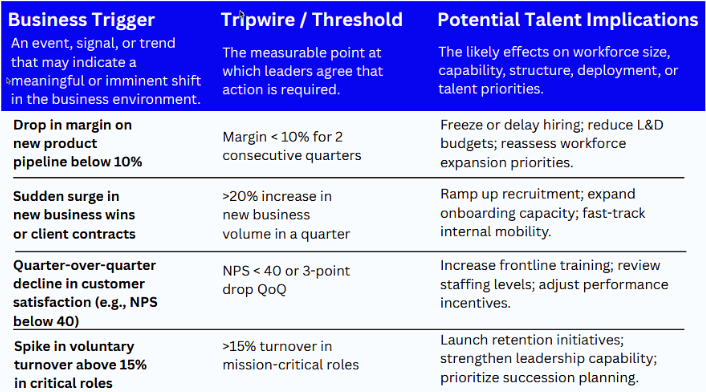
I recently shared my cheat sheet with 12 examples of talent tactics that might underpin a talent strategy, ranging from talent redeployment and automation to upskilling, along with guidance on when each tactic works well or not and examples in practice. But once strategies are set, business conditions often shift throughout the year, requiring reassessment of whether talent strategies still align with the business. To support those discussions, I’m sharing a one-page PDF I developed. The first column provides examples of Business triggers (events, signals, or trends indicating a meaningful or imminent shift in the business environment), followed by Tripwires or Thresholds (the measurable point at which leaders agree action is required), and Talent implications (likely effects on workforce size, capability, structure, deployment, or priorities). For example, a surge in new business wins (business trigger) and a more than 20 percent quarterly increase in volume (tripwire/threshold) may prompt talent implications such as ramping up recruitment, expanding onboarding capacity, or fast-tracking internal mobility. The 9 examples on my cheat sheet are intended to spark initial thinking rather than serve as a prescriptive list; teams should focus on identifying triggers most relevant to their own context. The goal is to envision possible business scenarios and talent responses so teams can adjust confidently as conditions evolve. For members of my private community for internal HR practitioners, Talent Edge Circle, our resource library includes additional pages to this document to help you identify triggers for your organization, along with a worksheet to document your thinking.
II. TALENT PRACTICES
Resources to help practitioners act on core talent practices by assessing whether ways of working and wellbeing practices support performance goals, enabling timely talent decisions, strengthening succession and development pipelines, improving internal mobility, and applying skills-based approaches.

PERFORMANCE MANAGEMENT
My cheat sheet to help teams assess if their current ways of working will enable 2026 performance objectives.

With the new year well underway, many organizations are developing, refining, or beginning to implement their 2026 objectives. Although much time is spent aligning on goals, defining metrics and KPIs, and refining the performance management process, less attention is often given to the ways of working that enable or hinder the achievement of those objectives. For example, an organization may set a clear objective to accelerate product delivery, yet slow decision-making, unclear ownership across functions, or excessive approval layers can erode progress long before performance metrics reveal a problem. Put differently, you can have the right objectives and the right people focused on them, yet it is often the ways of working that ultimately determine whether objectives translate into the desired performance outcomes. To surface these issues early, I created a one-page cheat sheet that leaders and their teams can use to identify which current ways of working could detract from goal achievement if left unaddressed. It is anchored in a simple but powerful question: “If we were to fast-forward to the end of 2026 and see that we fell short of this objective, which ways of working would we say got in our own way and contributed most to that result?” From there, teams identify two to three actions they can take immediately to reduce the likelihood of that outcome. Early action matters because once results are off track, the window to materially change performance outcomes narrows quickly. Take this action now to turn ways of working into an execution advantage rather than a performance risk.

WELLBEING & PERFORMANCE
Synthesizes evidence from 115 workplace wellbeing approaches to identify high-impact, feasible practices that improve employee well-being and performance.

Employee health and wellbeing are recognized as important for many reasons, including their role in enabling organizational performance. Yet many organizations have far less clarity on which practices most improve employee wellbeing while also strengthening performance outcomes. A new analysis from the McKinsey Health Institute helps close that gap by systematically reviewing 115 evidence-based workplace approaches. These approaches are organized across four dimensions of health, physical, mental, social, and spiritual, and evaluated using published academic evidence to assess their impact on health and work outcomes such as productivity, presenteeism, engagement, and innovation, along with feasibility based on ease of adoption, scalability, and ability to embed into daily work. The research is paired with an interactive tool (see post image) that allows practitioners to filter and compare wellbeing practices by health dimension, workforce objective, organizational level, and impact versus feasibility. One point I continue to emphasize for improving both employee wellbeing and organizational performance is ways of working (see resource 5 in this issue). Ineffective ways of working, such as slow decision-making or unclear ownership, often compound and undermine both employee wellbeing and organizational performance. With this as the backdrop, I am resharing an article by Jeremy Legg, Chief Technology Officer for AT&T, where he covers how AT&T was able to save 3.6 million hours over three and a half years and helped the company avoid more than $230 million in costs by improving ways of working.

TALENT MANAGEMENT
A companion resource to my cheat sheet with seven talent questions, adding indicators leaders can use to identify and act on talent decisions in real time.

Talent reviews and performance management are important talent practices that enable organizational performance. However, a common pitfall is treating these practices as scheduled process events, often confined to a specific time of year, rather than ongoing opportunities for proactive reflection and action. To promote this shift, I recently shared one of my cheat sheets with seven high-impact questions leaders can use to accelerate talent decisions at any moment, focused on areas such as upgrading talent in a critical role, identifying top retention risk, surfacing hidden talent, addressing ongoing subpar performance, creating stretch development, and unlocking workforce capacity. That resource helps leaders move from insight to action, where many talent efforts stall. To build on that cheat sheet, I’m sharing a complementary view to help identify which of those seven question areas present the greatest opportunity to act now. This view introduces sample indicators that signal where focus is most needed. For example, for Talent Upgrade in a Critical Role, the original question asks whether a critical role is filled by the best possible person, and what the next step should be taken. The added indicators include: A) There are known internal candidates who would likely outperform the incumbent, and B) If the role were vacant tomorrow, we would likely select a different and stronger candidate. These indicators help pinpoint where opportunities exist, and even one signal can highlight a talent decision that needs to be made.

SUCCESSION PLANNING
A curated set of five of my succession planning cheat sheets, each anchored in a practical question the resource helps you address.

With succession planning continuing to be a top priority among Talent Edge Weekly readers, this post brings together five of my succession planning templates, bundled here for easier access. Each is anchored in a core question the resource helps you answer: 1) How can we tell if our succession plan is “just names on a page,” and what practical steps can we take to fix it? (Five common warning signs, plus actions to address them.) 2) Which events should trigger an off-cycle review of our succession plans so they remain aligned with business realities? (Nine example trigger events that may warrant a faster reassessment.) 3) How should we reevaluate which roles belong in our succession planning pool as strategy, technology, and expectations evolve? (A one-page template to assess whether roles and successors still fit.) 4) What level of transparency about successor status is right for our organization? (Includes reflection questions to help you decide whether limited, partial, or full transparency is right for your organization.) 5) How can metrics help tell a more complete story about the health and impact of our succession plan? (24 example succession metrics across eight areas, including retention and internal mobility.) If resources like these are helpful and you want to go deeper with me and other internal HR practitioners to advance your most critical talent priorities faster and with less friction, apply to my private community for internal HR practitioners, Talent Edge Circle.
There is much more content in this issue, but you must be subscribed (or logged in if you are a subscriber) to access the rest. It is FREE to sign up, and a new issue comes out every Sunday, 6 PM EST! ⬇️