- Talent Edge Weekly
- Posts
- Talent Edge Weekly - Issue #344
Talent Edge Weekly - Issue #344
Role-based and pool-based succession planning, addressing the AI-readiness gap, reducing the likelihood of overhiring, skills-based talent practices, and scenario planning.

Brian Heger
April 26, 2026

SPONSORED BY

Welcome to this new issue of Talent Edge Weekly!
First, a shout-out to Ana Reynolds Murillo, Director of Global Talent Acquisition, Employer Branding, & Succession Planning at Yara International, for referring new subscribers to Talent Edge Weekly. Thank you, Ana, for your support of this newsletter!
PRESENTED BY TechWolf
What if AI doesn't cause a jobs crisis, but a worker shortage?
That was the line from Sven Smit (Senior Partner & Co-Chair, McKinsey Global Institute) that flipped our mental model in our recent podcast interview with him and MGI Partner Anu Madgavkar.
In an 8.5x larger global economy, even with 80% automation, the math points to a people shortage, not a surplus.
Three takeaways for HR leaders planning the next five years:
Tasks, not titles, are the unit of analysis. McKinsey: "Businesses succeed or fail based on workflows." TechWolf's Work Intelligence Index decomposes 50,000 tasks across 1,500 companies, so HR can see where AI automates, augments, or stays human-led.
The fastest learner wins. Five-year workforce plans are the wrong instrument. You need continuous learning metrics on capability, coverage, & improvement, which is exactly what TechWolf's AI delivers from the systems you already have.
Harden up, don't soften up. When the environment gets smarter, you don't survive by specializing in what AI isn't. You harden up. As skills shift between humans and agents, you need a live picture of who has what, where the gaps are, and which roles to redesign first.
The CHRO question Sven left us with: What are you doing, right now, not to learn AI, but to get equipped to lead through it?
THIS WEEK'S CONTENT
Below are links and descriptions of the topics covered in this issue. If you're interested in my deep dive, you can read the full newsletter.
Role-Based vs. Pool-Based Succession Planning: A Few Ideas for Determining the Right Approach | Brian Heger | My cheat sheet that helps HR practitioners evaluate whether to use role-based succession, pool-based succession, or a combination of both based on their organization's context.
How Leaders Can Close the AI Readiness Gap | The Conference Board | A new 28-minute podcast explores how CHROs can assess and accelerate AI maturity. AI fluency as a leadership expectation that influences succession and promotion decisions is also discussed.
8 Questions for Determining if a Vacant Position Should Be Backfilled | Brian Heger | My cheat sheet with questions to help leaders decide whether to backfill vacant roles, reducing the costly cycle of hiring, layoffs, and rehiring.
Rethinking Skills-Based Talent Models: 4 Paths to Business Value | Deloitte Insights | A new article based on an analysis of 87 organizations and more than 28 skills strategies shows why skills-based talent practices create the most value when anchored in specific business outcomes.
Beyond Tomorrow: Four Scenarios for the World of 2050 | BCG Henderson Institute | A new 48-page report presents four plausible scenarios for the world through 2050, two with direct workforce planning implications.
Also, check out my job cuts tracker & Chief HR Officer move of the week, which is an excerpt from my CHROs on the Go platform.
TALENT EDGE CIRCLE
👉️ If you’re an internal HR practitioner who wants to go deeper with me and other internal HR practitioners on talent topics tied to your most critical priorities, learn about my private community, Talent Edge Circle.
A special thanks to Kyle Forrest, U.S Future of HR Leader at Deloitte Consulting, for joining me and the Talent Edge Circle, this past week for a strategic discussion on agentic AI and reimagining the HR function! If you’re looking for big thinking backed by pragmatic actions on how CHROs and HR leadership teams are driving business value, I recommend connecting with Kyle. And if you missed it, check out Deloitte’s 2026 Global Human Capital Trends report. |

🗓️ May 6, Anna Tavis, thought leader and Department Chair, Human Capital Management at New York University, will join Talent Edge Circle for a discussion on how organizations are scaling digital and AI-enabled coaching.
⬇️ Now let’s dive in.

THIS WEEK'S EDGE

SUCCESSION PLANNING
My cheat sheet that helps HR practitioners evaluate whether to use role-based succession, pool-based succession, or a combination of both based on their organization's context.

One design decision many practitioners consider when implementing succession planning is whether to plan by specific role or talent pool. With role-based succession, you identify people as successors for a specific role. With pool-based succession, you develop people around shared capabilities that apply across multiple roles. Neither approach is automatically better; it depends on what your organization needs and how it operates. In many cases, the answer is both. Consider a retail organization with hundreds of store General Manager roles. For broader store operations, a pool-based approach may make more sense, since managing a separate plan for each similar role may not be realistic. However, for flagship locations with larger P&L responsibility, brand visibility, or strategic importance, a role-specific plan may be more appropriate. To help practitioners think through this decision, I’ve created a one-page cheat sheet to stimulate ideas. Since succession planning is as much art as science, the cheat sheet serves as a starting point, not a prescribed formula, to spark discussions that help determine the mix of approaches that best enables effective planning within your specific business context. These are the type of topics we discuss in my private community for internal HR practitioners, Talent Edge Circle.

AI IN THE WORKPLACE
A new 28-minute podcast explores how CHROs can assess and accelerate AI maturity. AI fluency as a leadership expectation that influences succession and promotion decisions is also discussed.

A new episode of The Conference Board’s C-Suite Perspectives podcast draws on findings from its 2026 Reimagined Workplace study, the seventh annual edition of the series, based on surveys of 271 human capital leaders and 333 U.S. workers. While there are several insights from this 28-minute discussion, one finding to highlight is that, using a five-stage AI maturity model, 60% of organizations remain at the two lowest levels of maturity, where experimentation is underway but still limited. Only 11% reported more advanced AI integration at Levels 4 and 5. The researchers found that as AI maturity increases, organizations are more likely to use AI fluency, such as understanding AI capabilities, AI risks and governance, and use cases that can create business value, in promotion and succession decisions. One implication is that as AI becomes more embedded in an organization’s operations and strategic priorities, AI fluency will increasingly become a leadership expectation. Within this context, one question HR and talent leaders can help their organization begin answering: Have we defined what AI fluency means for our organization, and are those expectations clearly communicated to employees before we begin factoring them into hiring, promotion, and succession decisions? The answers to questions like this can inform key aspects of talent strategy and practices in an AI-enabled workplace.

TALENT ACQUISITION
My cheat sheet with questions to help leaders decide whether to backfill vacant roles, reducing the costly cycle of hiring, layoffs, and rehiring.

As I've tracked thousands of layoffs over the past few years through my layoff tracker, over-hiring has consistently been among the most cited reasons organizations give for workforce reductions, resulting in costly cycles of hiring, layoffs, and rehiring. While better workforce planning can help minimize over-hiring, an equally important and often overlooked practice is to be more intentional about whether vacant roles need to be backfilled. Rather than automatically backfilling, HR and talent acquisition practitioners have an opportunity to help hiring managers reimagine how work is delivered and whether a backfill is the best talent choice, especially at a time when shifts in how work gets done are outpacing most organizations' ability to respond. To help facilitate these discussions, here is my one-page cheat sheet with eight sample questions designed to spark deeper evaluation and better hiring choices. A few examples: Is this role likely to remain needed in two years, adding a future-oriented perspective to what can otherwise be a reactive decision? Would technology such as AI or process redesign significantly change how this work is done, assessing the risk of role obsolescence before committing to a hire? As a bonus, I am resharing my my cheat sheet to help leaders identify opportunities for delivering work through short-term projects in an internal talent marketplace, tapping into existing workforce capacity while creating growth and development opportunities.

SKILLS-BASED TALENT PRACTICES
A new article based on an analysis of 87 organizations and more than 28 skills strategies shows why skills-based talent practices create the most value when anchored in specific business outcomes.

As HR leaders and their teams continue moving toward skills-based talent practices, this new Deloitte Insights article offers a useful reset on what actually creates value. Based on an analysis of 87 organizations using more than 28 skills strategies, the research finds that organizations creating measurable value from skills-based approaches start by defining a specific business outcome rather than by building a comprehensive skills infrastructure. Four common outcomes include becoming an employer of choice, improving productivity, building agility, and driving innovation. Once the outcome is identified, organizations can apply a targeted set of skills practices to support it, since different practices disproportionately influence specific outcomes. For example, organizations pursuing the employer-of-choice outcome prioritize internal talent marketplaces and self-reported skills, those focused on agility invest in validated assessments and skill-to-job mapping, and those aiming for innovation lean into skills-based workforce planning. These insights can help HR teams anchor skills-based practices in the business outcomes they are intended to influence. With that as the backdrop, I am resharing my one-page cheat sheet, Framing Talent Initiatives Within the Business Context, which can help anchor any talent or HR initiative in the business problem or opportunity it is meant to address.

SCENARIO PLANNING
A new 48-page report presents four plausible scenarios for the world through 2050, two with direct workforce planning implications.

I've written several posts and shared many tools on scenario planning as a critical tool for envisioning possible business futures and informing talent strategies. Building on those resources, a new 48-page BCG Henderson Institute report, drawn from more than 100 megatrends and a century of historical data, presents four distinct, plausible scenarios for the world through 2050. Two are especially relevant for workforce planning: AI Abundance (AI and robotics reshape work and leisure, driving exceptional labor productivity growth and a 25% reduction in average working hours) and Battling Blocs (geopolitical fragmentation compresses global talent mobility and cross-border labor flows). In the AI Abundance scenario specifically, average annual working hours fall from 2,100 to 1,600 — a 25% decline driven by task automation. The report notes this shift produces a fundamentally different relationship between work and identity, as employees maintain high quality of life while working significantly fewer hours. Beyond the specific scenarios, I am sharing this report as a broader example of scenario planning and how the outputs can inform strategic planning. Appendix 1 shows a three-step process to get the most out of scenarios and can be useful for those responsible for or involved in strategic business and talent planning for their organizations. As a bonus, I’m resharing my cheat sheet, Using Scenario Planning to Inform Workforce Planning.
MOST POPULAR FROM LAST WEEK
SUCCESSION PLANNING
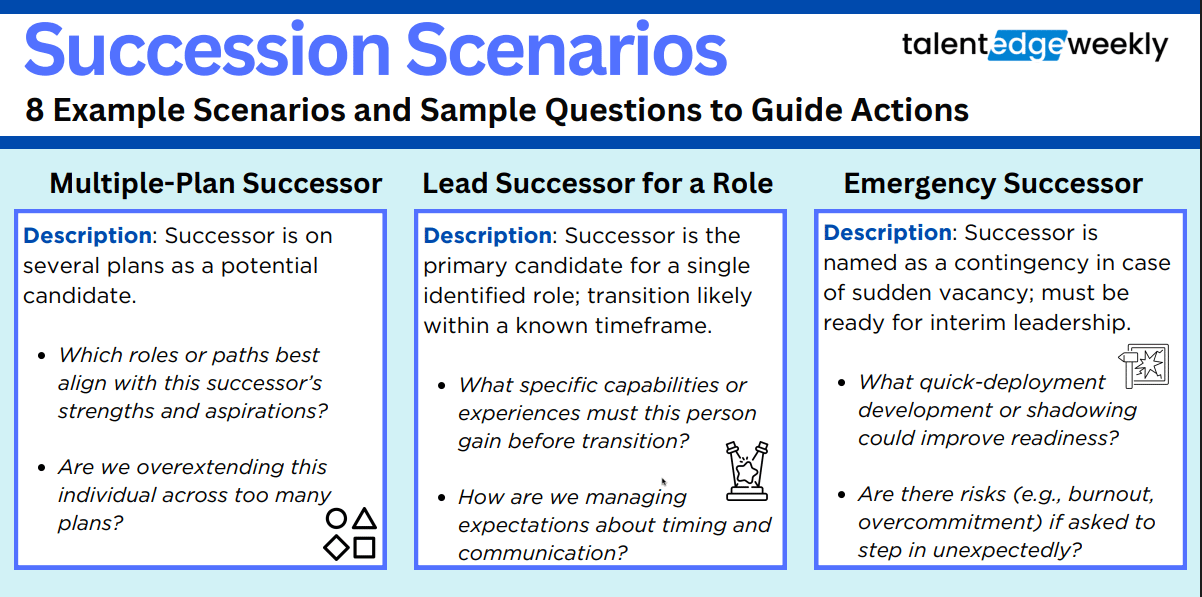
My cheat sheet with with eight succession scenarios, each requiring distinct talent actions to keep plans current, relevant, and actionable.
JOB CUTS AND LAYOFF TRACKER
Check out my tracker of announcements from a segment of organizations that have conducted job cuts and layoffs since the start of 2023.
A few job cuts announced this past week:
Meta Platforms (NASDAQ: META). The social media and technology company plans to cut approximately 8,000 employees — roughly 10% of its global workforce — in the first of what is expected to be multiple rounds of layoffs in 2026. The cuts are tied to a massive reallocation toward AI infrastructure, with the company's 2026 capital expenditure guidance running as high as $135 billion.
Nike (NYSE: NKE). The sportswear company announced approximately 1,400 layoffs concentrated in its global operations division, with the majority in technology, affecting employees across North America, Asia, and Europe. The cuts represent less than 2% of Nike's total global workforce and are part of the company's "Win Now" turnaround strategy, which includes consolidating technology operations into two primary hubs as well as integrating its materials supply chain into its footwear and apparel teams.
Starbucks (NASDAQ: SBUX). The coffee chain cut an undisclosed number of jobs in its technology organization, with program managers, product managers, and other tech roles among those affected. The reductions were driven by new CTO Anand Varadarajan, who joined from Amazon in January, and are part of a broader restructuring under CEO Brian Niccol's ongoing turnaround effort; the company told staff it was making structural changes to sharpen focus and move faster on its highest priorities.
CHIEF HR OFFICER MOVE OF THE WEEK
This past week, several new CHRO announcements were posted on CHROs on the Go, my digital platform tracking movement in and out of the CHRO role.
This week’s highlight is:
XBP Global (IRVING, TEXAS) [NASDAQ: XBP] — a multinational technology and services company — announced the appointment of Acquelia Colaco as Chief HR Officer. Colaco most recently served as Head of Colleague Experience at Tesco Business Solutions. Prior to Tesco, she held senior HR roles at Infosys spanning more than six years. In her new role, Colaco will lead the global people's agenda across the Americas, Europe, and Asia, with a mandate to align talent, leadership, and culture with the company's AI-first transformation strategy across its approximately 10,600 employees in 20 countries.

🔑 To access all detailed CHRO announcements from this past week and over 4,500 archived announcements, join CHROs on the Go. It’s the easiest way to stay informed about movement in and out of the Chief HR role.
If you are already a subscriber to CHROs on the Go, log in here.
TALENT EDGE CIRCLE
👉️ If you’re an internal HR practitioner who wants to go deeper with me and other internal HR practitioners on talent topics tied to your most critical priorities, learn about my private community, Talent Edge Circle.
Screenshot of recent discussion with Cole Napper on Data-driven HR
FROM ME ON LINKEDIN
Catch up on what you may have missed from me on LinkedIn:
THE BEST OF MARCH 2026
Did you miss the “Best of March ” issue of Talent Edge Weekly? If so, check out issue #340, which includes the most popular resources from the month. Thank you to Noota for sponsoring this issue. If your recruiting team is bogged down in operational work, losing valuable time to hire the best talent, get a free trial of Noota’s AI agent for recruiting teams.
Want to get your brand, product, or service in front of our active 57,000+ Talent Edge Weekly subscribers? Learn how to become a potential sponsor.
Talent Edge Weekly is written by Brian Heger, a human resources practitioner. You can connect with Brian on LinkedIn and brianheger.com
🗣️ WANT MORE?
Want access to all my curated resources?
👉️ Visit my website, brianheger.com
Are you an internal HR practitioner?
👉️ Apply for my private, paid community, Talent Edge Circle
Are you a provider of HR-related services?
👉️ Become a sponsor of Talent Edge Weekly
Want to know who’s moving in and out of the CHRO role?
👉️ Join my CHROS on the Go subscription