- Talent Edge Weekly
- Pages
- Talent Edge Weekly - Best of March 2026

SPONSORED BY

Welcome to this special Best of March issue of Talent Edge Weekly!
First, a shout-out to Ana Reynolds Murillo, Director of Global Talent Acquisition, Employer Branding, & Succession Planning at Yara International, for referring new subscribers to Talent Edge Weekly. Thank you, Ana, for your support of this newsletter!
Not subscribed to Talent Edge Weekly? Subscribe here for free!
PRESENTED BY Noota
Is your recruiting team bogged down in operational work, losing valuable time to hire the best talent?
Recruiters create the most value when they can focus on attracting and hiring top talent. But too much capacity still gets pulled into:
Time-consuming sourcing: Hours lost searching LinkedIn, job boards, and resume databases
Manual screening: Qualification calls, overloaded calendars, and inconsistent processes
Messy ATS workflows: Double data entry, missing information, and broken pipelines
Poor alignment: Unclear briefs with hiring managers and delayed feedback
Noota is an AI agent platform that helps recruiting teams reduce busywork so they can make better, faster hiring decisions. It’s trusted by 200,000 users and more than 5,000 enterprise teams worldwide.
To see what’s possible, start a free trial of Noota today.
Prefer a closer look first? Book a 30-minute demo
THIS MONTH’S CONTENT
This Best of March issue includes the 15 most popular resources from the March issues of Talent Edge Weekly. They span three sections:
CHRO Priorities & HR Strategy. Explores reports and insights shaping the HR agenda in 2026, including the future of work, top CHRO priorities, AI within the HR function, the evolving role of first-time Chief HR Officers, and whether traditional organizational functions are still fit for purpose.
Talent Practices. Highlights practical resources and ideas to help strengthen talent decisions and talent-management practices, including proactive talent decisions, preventing goal creep, succession planning, overlooked sources of talent such as caregivers, and what it takes to make skills-based hiring work.
AI & the Labor Market. Examines how AI and broader labor-market shifts are influencing work and workforce decisions, including where AI adoption still lags behind theoretical capability, what remains uncertain about AI’s labor-market effects, how to track labor-market trends, and how organizations are redesigning workflows to capture AI’s potential.
There are bonus resources, such as information about company layoffs and movement in and out of the Chief HR Officer role.
INTERNAL HR PRACTITIONER?
If you’re an internal HR practitioner who wants to go deeper with me and other internal HR practitioners on talent topics tied to your most critical priorities, learn about my private community, Talent Edge Circle.
Let’s dive in. ⬇️

THIS MONTH’S EDGE
I. CHRO PRIORITIES & HR STRATEGY
Explores reports and insights shaping the HR agenda in 2026, including the future of work, top CHRO priorities, AI within the HR function, the evolving role of first-time Chief HR Officers, and whether traditional organizational functions are still fit for purpose.

HR PRIORITIES
A new 32-page report that examines 28 people and talent practices, identifies top CHRO priorities, and outlines four strategic moves for driving greater business value.

BCG and the World Federation of People Management Association (WFPMA) released its 2026 edition of their Creating People Advantage report, the latest in a series spanning two decades. Drawing on responses from more than 7,000 HR and business leaders, the report assesses 28 people and talent practices. One of the most revealing visuals is Exhibit 3 on page 8, which maps those practices by current capability and future importance to show where the biggest gaps exist. Strategic workforce planning (SWP) ranks #4 this year among the topics with the largest gap between future importance and current capability, and its importance has risen from #5 to #2 since 2023. Given that SWP shows up year after year as a critical priority with limited capability, at some point we need to ask: when will we begin closing the SWP capability gap in meaningful ways, and what will it take? One place to start is by clarifying the business cost of not prioritizing SWP. To help teams do that, I’m resharing my one-page template that connects a business problem or opportunity to a talent solution such as SWP, while clarifying the cost of inaction and the data that supports the case. Talent Edge Circle members can also access a diagnostic tool in our resource library to assess how well their talent and HR initiatives connect to the business problems they solve and the stakeholder value they create.

FUTURE OF WORK
A new 79-page report explores issues shaping the future of work, workforce, and workplace. I expand on the volume of change workers are experiencing.

Deloitte released its 2026 Global Human Capital Trends report, a 79-page resource that explores the forces reshaping work, the workforce, and the workplace. One chapter beginning on page 55 puts numbers behind something many HR practitioners already feel: workers are being asked to absorb a relentless volume of change, but most organizations are still not equipped to help employees adapt at that pace. Deloitte found that one-third of workers experienced 15 major changes in the past year alone, with that level of change taking a toll on well-being and workload. Yet only 27% of respondents believe their organizations manage change effectively. Deloitte recommends moving beyond traditional change management and formal training by building adaptation into daily work. As I’ve pointed out before, many changes are introduced simultaneously not because leaders intend to overload the organization, but because they often lack visibility into the cumulative change load and sufficient coordination across initiatives. That is why I am resharing my cheat sheet to help leaders review current and proposed changes, their timing, and their impact across groups. It serves as a starting point for better aligning the pace of change with employees’ capacity to adapt, helping improve the success of change efforts while preserving employee well-being.

HR PRIORITIES AND AI
A new 16-page annual survey of CHROs taps into their priorities and concerns for 2026, including AI within the HR function.

This past week, the CHRO Association, in partnership with the Darla Moore School of Business, released its annual survey of approximately 150 CHROs on their priorities and concerns for 2026. While the 16-page report covers several topics, one key headline is that 91% of CHROs cite AI and workplace digitization as their most immediate concern. One reason behind that concern is that while productivity and efficiency gains are often cited as top reasons for AI-related investments, nearly half (47%) of CHROs report their organizations have not yet established clear productivity measures to measure return on investment. The report also notes that AI investments in HR are concentrated in a few areas, such as talent acquisition and recruiting automation and HR service delivery and self-service, raising an important question: where else might HR teams be overlooking opportunities to create business value? This creates an opportunity for HR teams to take a more intentional approach to identifying where AI can create the greatest business value, rather than focusing only on a narrow set of familiar use cases. To support that, I’m resharing my one-page editable worksheet that helps teams identify which AI-enabled HR use cases are most likely to generate stakeholder value by working through the business need, solution, expected outcomes, ROI, risks, and next steps.

CHIEF HR OFFICER
Highlights eight enablers of success for first-time Chief HR Officers. I build on one: being a commercial business leader first and an HR leader second.

Since 2021, I’ve tracked roughly 5,000 moves in and out of the Chief HR and People Officer role through CHROs on the Go—my subscription-based platform covering hires, promotions, and resignations in the CHRO role. One encouraging trend is when these moves create opportunities for first-time Chief HR Officers. This newly updated 17-page paper from Heidrick & Struggles outlines eight enablers of success in a first-time Chief HR role, including being a commercial business leader first and an HR leader second, assembling the right HR team, and enabling the business in the age of AI. On the idea of being a commercial business leader first, my take is that effective heads of HR, whether newly appointed or seasoned, not only build this capability within themselves, but also enable it throughout the HR organization by expecting teams to anchor their work in the business problems they help solve and the stakeholder value they create. With that as the backdrop, I’m resharing my slide for framing HR work in business terms. For those in my private community for internal HR practitioners, Talent Edge Circle, our resource library also includes an additional editable diagnostic to help HR connect its work more clearly to business priorities and stakeholder value.

ORGANIZATION DESIGN
Examines whether traditional corporate function structures are still fit for purpose and offers a framework for evaluating whether design decisions should be organized around strategic outcomes.
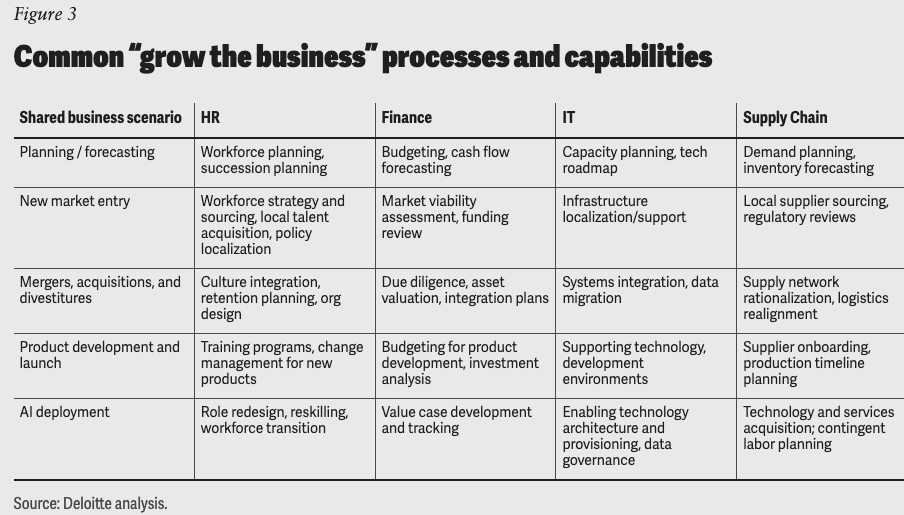
As organizations rethink how work gets organized in response to AI, faster business cycles, and growing pressure for cross-functional execution, this Deloitte Insights article raises an important question: are traditional corporate functions such as HR, finance, IT, legal, and procurement still fit for purpose? Its core argument is that these functions were designed for specialization and efficiency, but many are no longer set up to support the speed, agility, and coordination that today's business priorities require, and Deloitte's survey of 9,000+ leaders found only 7% are making great progress here. One framework in the article separates work that helps "run the business" from work that helps "grow the business." Run-the-business work covers repeatable, transaction-heavy activities suited for standardization, automation, and shared delivery models. Grow-the-business work (as shown in the post image) centers on strategic scenarios such as AI deployment, M&A, and market expansion, where success depends on aligning expertise around a shared outcome and is better suited for cross-functional teams organized around those outcomes. The distinction matters for design: not all functional work should be reorganized the same way, and clarity on which category a given activity falls into can help leaders make more deliberate decisions about structure, accountability, and where to invest in capability.
II. TALENT PRACTICES
Highlights practical resources and ideas to help strengthen talent decisions and talent-management practices, including proactive talent decisions, preventing goal creep, succession planning, overlooked sources of talent such as caregivers, and what it takes to make skills-based hiring work.

TALENT MANAGEMENT
My cheat sheet with nine examples of proactive talent decisions to help leaders build talent management as an ongoing capability.

Organizational talent processes and practices, such as talent reviews and performance management, are critical enablers of organizational performance. Yet a common pitfall is treating them as areas of focus only at a few select times of the year rather than as opportunities for ongoing, proactive talent decisions. When we rely too heavily on formal processes to make important talent decisions, two things happen: 1) we fail to build the organizational muscle to make better, faster talent decisions in the daily flow of work, and 2) we miss or delay opportunities to drive organizational performance through more intentional talent management. My cheat sheet includes nine examples that can help leaders and managers accelerate talent decisions at any moment. Talent Upgrade in a Critical Role, for example, asks whether a critical role is filled by the person best suited to drive business impact and what the next step is if a change is needed. Formal talent processes serve an important purpose, but leaders should also use the daily flow of work to create more opportunities to drive organizational performance through talent management.

PERFORMANCE MANAGEMENT
My one-page cheat sheet helps organizations address goal creep by evaluating newly added goals through explicit discussions about capacity, priorities, and trade-offs.
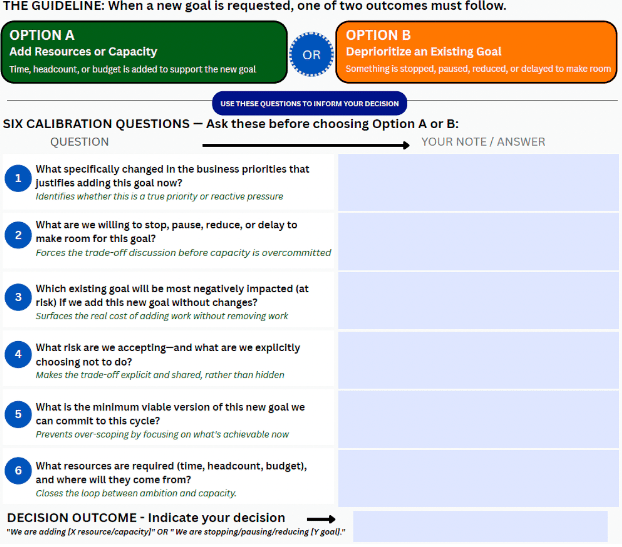
Performance goals and objectives for the year are already well underway. Even with goals set and resourced at the start of the cycle, it often doesn’t take long before new goals are added to an existing plan. If these additions aren’t managed intentionally, they can introduce competing priorities that outpace capacity, putting both original and new objectives at risk. This is often referred to as goal creep, when goals expand without recalibrating priorities and resources. To help teams address this, here’s my new one-page cheat sheet to evaluate any new goal and clarify what will change to make room for it. It starts with a simple premise: when a new goal is added, one of two things should happen. Either resources are added to support it, or an existing goal is deprioritized to make room. The tool also includes six questions to guide the discussion, such as: What specifically changed in the business priorities that justifies adding this goal now? What are we willing to deprioritize to make room? What is the minimum viable version of this new goal we can commit to this cycle? This tool isn’t meant to be rigid. It’s a strategic exercise to stay intentional about what work is taken on, protect critical business priorities, and strengthen company performance, which is a core aim of performance management.

SUCCESSION PLANNING
My one-page diagnostic helps practitioners assess 10 sample areas to identify opportunities to improve their succession planning practices.

Succession planning (SP) continues to be a top priority for many organizations, and it is one of the topics Talent Edge Weekly readers most often ask me to cover. But in many cases, organizations do not struggle because they lack interest in SP. They struggle because they have not clearly identified where their SP practices need to improve to drive greater impact. Against that backdrop, I’m sharing my one-page diagnostic to help organizations identify opportunities to strengthen their SP. It covers 10 sample areas and, while not exhaustive, offers a practical starting point for assessing where the process may need more attention. Practitioners can review each statement and select one of three rating categories, including Needs Attention for areas with significant opportunity for improvement. For example, one area is Business Strategy Alignment: “Our succession planning process is aligned with the organization’s long-term strategic goals and regularly reviewed to adapt to changing business needs.” Once completed, the diagnostic provides a visual snapshot of results through color-coded boxes based on the selected ratings, which can help identify priorities for follow-up action. These 10 areas are intended as starting points, so adapt and modify them as needed for your organization. As a bonus, here is another one of my cheat sheets to help you reevaluate if changes are needed to a succession plan.

TALENT ACQUISITION
Explores the case for viewing caregivers who have taken time away from work to care for others as a valuable source of talent.
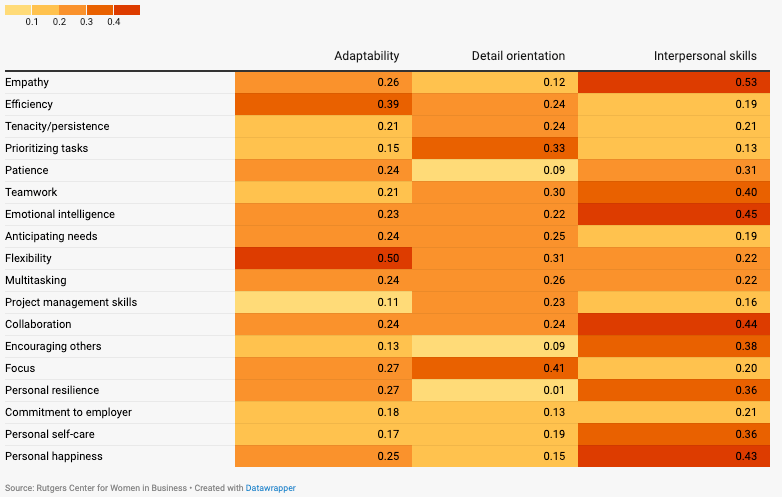
Talent acquisition teams are constantly looking for new sources of talent. One often-overlooked strategy is to tap into “hidden workers,” individuals with valuable skills who are frequently missed because of hiring practices, policies, or technology. I previously shared my one-page cheat sheet with nine examples of these worker segments, including retirees seeking to reenter the workforce and caregivers who have stepped away from work to care for children, elderly parents, or other family members and friends. This new MIT article zeroes in on caregivers and makes the case that employers may be overlooking a talent segment that has developed many of the human skills organizations increasingly need. Drawing on research from the Rutgers Center for Women in Business, the authors found that caregiving helps build capabilities such as empathy, adaptability, time management, problem-solving, and managing complexity, with many of the core workplace and leadership skills employers increasingly value. In a workplace being reshaped by AI, that matters because these human capabilities are becoming even more important. For organizations, the takeaway is that treating caregiving as a resume gap may cause them to miss strong talent, while those that better recognize these skills may strengthen talent pipelines. Which overlooked talent segments could your organization better engage to strengthen its talent pipeline?

SKILLS-BASED HIRING & CREDENTIALS
Credential Fluency: The Hiring Advantage in the Race for Skills | Burning Glass Institute and OneTen
A new 31-page report shows why removing degree requirements alone isn't enough to make skills-based hiring work and what organizations must do instead.

In February 2024, I shared a Harvard Business School and Burning Glass Institute report, Skills-Based Hiring: The Long Road from Pronouncements to Practice. Based on 11,300 roles at large firms, it found that removing degree requirements produced only a 3.5 percentage point increase in hiring workers without a bachelor’s degree. A new study from the Burning Glass Institute and OneTen, analyzing more than 1,000 major U.S. employers, reinforces that pattern. Removing degree requirements alone produced only a 2 percentage point increase in non-degreed hires. But firms in the top 10% of “credential fluency” were 11 percentage points more likely to hire credentialed workers. What makes the difference: mapping credentials to roles, embedding them in applicant tracking systems, training hiring managers to assess them, and signaling them in job postings and recruiting materials. For example, Infosys names AWS Architect certifications in postings, while HubSpot does the same for Inbound Marketing certifications. The report also surfaces a tech paradox: tech firms rarely list credential requirements, yet are most likely to hire credentialed workers. Overall, skills-based hiring requires more than removing degree requirements. It demands embedding a range of operational practices into how organizations actually hire, of which credential fluency is one practical example. To support that effort, here is one of my cheat sheets: 9 Questions for Evaluating if Degrees Are Required for a Role.

SKILLS-BASED TALENT PRACTICES
A 40-page report on moving beyond degree-only talent credentials toward skills-based hiring. I share my cheat sheet to help evaluate those decisions.

With more organizations seeking to evolve talent practices around skills, this new paper from the World Governments Summit, produced with PwC, offers ideas for moving beyond degree-only talent signals toward a more skills-focused approach where people build and prove skills over time through smaller credentials that build on each other. One idea in the report is to treat degrees as one signal, not the signal, while increasingly embracing skills-based hiring that prioritizes candidates’ skills over traditional credentials. This connects to a question I’ve raised several times: as more firms remove degree requirements from job postings, are they truly hiring more candidates without degrees? Research from Harvard Business School and the Burning Glass Institute shows that simply dropping degree requirements has limited impact unless organizations also redesign role requirements, candidate evaluation, and hiring practices. One way to do this is to stress-test degree requirements against specific roles and lines of work. To support this effort, I’m resharing my one‑page cheat sheet with nine skills-based hiring questions to help make these decisions more intentional.
III. AI & THE LABOR MARKET
Examines how AI and broader labor-market shifts are influencing work and workforce decisions, including where AI adoption still lags behind theoretical capability, what remains uncertain about AI’s labor-market effects, how to track labor-market trends, and how organizations are redesigning workflows to capture AI’s potential.

AI’S IMPACT
A new analysis argues that many questions about AI’s workforce implications remain unresolved, helping distinguish signals from evidence.

In this new Brookings Hamilton Project analysis report, economist Jed Kolko argues that the biggest questions about AI and the labor market remain unanswered for three reasons: 1) early findings on labor demand are inconclusive in part because there are now numerous AI exposure and usage measures being used in AI research, and they do not fully agree on which occupations are most affected; 2) current findings are weak signals about the future given how recently LLMs entered widespread use; and 3) labor demand is only one slice of a much bigger picture that also includes productivity, labor supply, and transition dynamics, meaning how smooth or disruptive the workforce transition may be along the way. One caution for practitioners is Kolko's warning about "streetlamp bias," or the tendency to focus on what is easiest to measure rather than where the most important effects may actually be emerging. For HR leaders, the implication is to build workforce strategies that are grounded in the available evidence, flexible enough to adapt as the research matures, and be clear with stakeholders about what is known versus what remains uncertain. You can get more recent reports on the impact of AI on jobs, work, and the labor market here on my website.

AI’S IMPACT ON WORK
A new 17-page report compares AI’s theoretical capability potential with real-world usage data, showing where adoption still lags.

HR practitioners continue to tap into data and insights to help their organizations understand and prepare for AI’s impact on jobs and work. With this in mind, I recently shared two useful resources: 1) The Brookings Institution analysis pairing AI exposure with an “adaptive capacity” index to show where worker resilience is high or vulnerability is concentrated; and 2) HBS Working Knowledge research on how AI is shifting job demand, including an interactive tool showing which occupations are more likely to be enhanced versus eliminated. This past week, a new 17-page report from Anthropic was also widely shared. Using a new metric, “observed exposure,” it compares theoretical AI capability with real-world usage data and finds that, in most sectors, actual adoption remains only a fraction of what AI is theoretically capable of doing. One implication I draw for workforce planning and related areas is that organizations should not treat AI’s potential capability as the same thing as immediate workforce impact. Instead, leaders should distinguish between roles/jobs/work with high theoretical but low actual adoption, high actual adoption, and low exposure. Those distinctions matter because they lead to different conclusions, prioritization, and actions. Relying only on theoretical exposure could prematurely lead to workforce reductions or restructuring. A better use of this data is to identify where role redesign, reskilling, and shifts in productivity expectations are most likely to emerge first so efforts can be prioritized more thoughtfully.

LABOR MARKET TOOL
A tool that helps users explore employment, labor force participation, and unemployment trends by demographic group, which is useful for workforce planning.

Many HR practitioners track headline job numbers without access to disaggregated demographic data on employment and labor force participation. While headline data is a useful starting point, segmenting it can help HR practitioners bring more granular supply-side analysis into workforce planning. This open-access interactive labor market tracker from The Hamilton Project at the Brookings Institution, updated February 25, 2026, helps do that. The tool allows users to explore employment, labor force participation, and unemployment trends by sex, age, race and ethnicity, nativity, education, disability status, and parental status, enabling a more nuanced view of workforce supply than standard Bureau of Labor Statistics (BLS) releases typically provide. The latest update also reflects significant revisions to January 2026 population estimates after the Census Bureau incorporated updated migration data, reducing measured labor force and employment levels and lowering the labor force participation rate. That serves as an important reminder that even official labor market data is subject to meaningful revision and that workforce plans built on point-in-time assumptions may carry more uncertainty than many planning processes acknowledge. For HR practitioners tracking labor supply in specific talent pools, this is an open-access resource worth bookmarking.

AI & WORK FLOWS
A new 43-page report on how leading organizations are using AI to redesign core workflows, including workforce planning, rather than simply automating isolated tasks.

The World Economic Forum just released a new 43-page white paper on how organizations are using AI to redesign core workflows, not just automate isolated tasks. One section that stood out to me is Focus 4 on predictive, AI-powered strategic planning, which describes a shift from relying on one fixed plan to continuously comparing options and reallocating resources as conditions change. A case study on Canada Goose makes that tangible: the company used an AI scenario planning system to accelerate financial planning, rerun scenarios more quickly, reduce planning cycle time by 60%, and improve revenue forecast accuracy by 4%. The report then extends this same logic into workforce planning in Focus 5, where planning becomes less about static headcount plans and more about continuously sensing capability gaps, evaluating scenarios, and reallocating talent as needs shift. That is one reason I’m resharing my one-page cheat sheet with questions and tips to help HR teams think through how talent and work needs may shift under different business scenarios. Even directional planning is better than none at all, and thinking through this ahead of time can make the difference between responding effectively to changing business conditions and falling short of key business targets. In other words, do not wait until you have everything figured out—the technology, the process, or the perfect data—to get started.
JOB CUTS TRACKER
Here is my tracker, which includes announcements from a segment of organizations that have announced job cuts and layoffs since the start of 2023.
A few announcements from March:
Algoma Steel (TSX: ALGOMA). The Canadian steel manufacturer began laying off approximately 1,000 employees, about 42% of its Sault Ste. Marie, Ontario workforce — effective March 23 as it closed its blast furnace and coke-making operations to transition to electric arc steelmaking. U.S. tariffs on Canadian steel accelerated the timeline by roughly a year from what had originally been planned.
Atlassian (NASDAQ: TEAM). The software company plans to lay off around 10% of its workforce, or 1,600 employees, to push into AI and enterprise sales. The majority of impacted employees are in North America, amounting to 40%, followed by 30% in Australia and 16% in India.
Evotec (NASDAQ: EVO). The drug discovery and development company is laying off up to 800 employees, about one-sixth of its global workforce, in a restructuring that also includes the shutdown of four facilities and other moves intended to cut costs, accelerate company growth, and speed up operations. The layoffs will occur across all its 14 locations in Europe and the U.S.
Nokia (NYSE: NOK). The Finnish telecommunications equipment company is reportedly planning to cut up to 14,000 jobs globally, or roughly 20% of its approximately 74,000-person workforce, as part of a restructuring driven by slowing demand for 5G infrastructure and declining revenues. India, where Nokia employs more than 17,000 people, is expected to be among the markets impacted, though exact figures have not been confirmed by the company.
Volkswagen (OTCMKTS: VWAPY). Europe’s largest carmaker plans to cut up to 50,000 jobs in Germany by 2030 as its profits dropped to their lowest level since 2016. Post-tax profits have fallen by around 44% in 2025. The cuts will take place across its core brand, Audi, Porsche, and software unit Cariad.
CHIEF HR OFFICER MOVES
In March, I tracked 67 hires, promotions, and resignations in the Chief HR Officer (CHRO) role through CHROs on the Go, my subscription-based digital platform that monitors movement in the CHRO role.
A few headlines from March:
Fulton Financial Corporation (LANCASTER, PENNSYLVANIA) [NASDAQ: FULT]— a $32 billion financial holding company—announced that Chief HR Officer Bernadette Taylor will retire from Fulton on June 5, 2026, and that Karen Grafje, currently EVP, Director of Total Rewards and HR Solutions, will be promoted to CHRO. Karen joined Fulton in January 2023.
Palo Alto Networks (SANTA CLARA, CA) [NASDAQ: PANW] — a global cybersecurity company — announced the appointment of Danielle Gonzalez as Chief People Officer. Gonzalez, who joined Palo Alto Networks in 2019, was most recently SVP of the People Team for the company's Go-to-Market and Next-Generation Security businesses, where she also oversaw global employee relations. Prior to Palo Alto Networks, she held HR leadership roles at TiVo, eBay, Alta Devices, and Rovi Corporation.
Parsons Corporation (CHANTILLY, VIRGINIA) [NYSE: PSN] — a leading disruptive technology provider in the national security and global infrastructure markets — announced the promotion of Soo Lagasse to Chief HR Officer, effective April 1, 2026. Lagasse, who currently serves as SVP of Global Talent Acquisition and Mobility at Parsons, succeeds Susan Balaguer, who will retire this spring.
ScanSource, Inc. (GREENVILLE, SOUTH CAROLINA) [NASDAQ: SCSC]— announced in its Form 8-K that Alexandre Conde, SVP and Chief People Officer since 2022, will transition to SVP, Strategy, effective March 16, 2026, and that Michael Webb has been hired as SVP and Chief HR Officer, also effective March 16, 2026. Webb joins from Rogers Corporation, where he served as SVP, Chief Human Resources Officer since April 2023.
Join CHROs on the Go to access all detailed 67 announcements from March and +4,500 archived announcements. Monthly + annual subscriptions available.
If you are already a subscriber to CHROs on the Go, log in here.
INTERNAL HR PRACTITIONER?
If you’re an internal HR practitioner who wants to go deeper with me and other internal HR practitioners on talent topics tied to your most critical priorities, learn about my private community, Talent Edge Circle.
I look forward to sharing more resources with you throughout April. Have a great month ahead, and I’ll see you in next week’s regular issue!
Talent Edge Weekly is written by Brian Heger, an internal human resources practitioner. You can connect with Brian on LinkedIn and brianheger.com