- Talent Edge Weekly
- Posts
- Talent Edge Weekly - Issue #343
Talent Edge Weekly - Issue #343
AI Index report, 2026 State of Global Workplace report, work redesign, ensuring critical roles are filled with top talent, and succession planning scenarios.

Brian Heger
April 19, 2026

PRESENTED BY

Welcome to this new issue of Talent Edge Weekly!
First, a shout-out to Tania Philipp, Chief People Officer at Lakefront Biotherapeutics NV, for referring new subscribers to Talent Edge Weekly. Thank you, Tania, for your support of this newsletter!
PRESENTED BY Talent Edge Circle
My private community for internal HR practitioners
If you’re part of my private community for internal HR practitioners, Talent Edge Circle, we have two upcoming discussions:
April 22, Kyle Forrest, U.S. Future of HR Practice Leader at Deloitte, will join us for a strategic discussion on agentic AI and its implications for HR.
May 6, Anna Tavis, thought leader and Department Chair, Human Capital Management at New York University, will join us for a discussion on how organizations are scaling digital and AI-enabled coaching.
If you’re an internal HR practitioner who wants to go deeper with me and other internal HR practitioners on topics tied to your most critical talent priorities, learn more about Talent Edge Circle.
THIS WEEK'S CONTENT
Below are links and descriptions of the topics covered in this issue. If you're interested in my deep dive, you can read the full newsletter.
2026 AI Index Report | Stanford Institute for Human-Centered AI | A new 400+ page report that provides the most comprehensive annual AI state-of-the-field report. I hone in on one finding related to early-career roles.
State of the Global Workplace 2026: The Human Side of the AI Revolution | Gallup | Gallup’s new 2026 edition of its annual global workplace report offers insights on various aspects of employee sentiment and engagement.
Work Redesign: Reinvent for a Human Advantage | Mercer | A 20-page paper focused on how work redesign in an AI era should start not with the technology, but with one question: what work actually needs to be done?
Are Your Most Critical Roles Occupied by Your Top Talent? | Brian Heger | A few of my slides to help leaders evaluate whether their organization’s top talent is occupying its most critical roles.
Succession Planning: Taking Action Based on Scenario Type | Brian Heger | My cheat sheet with with eight succession scenarios, each requiring distinct talent actions to keep plans current, relevant, and actionable.
Also, check out my job cuts tracker & Chief HR Officer move of the week, which is an excerpt from my CHROs on the Go platform.
⬇️ Now let’s dive in.

THIS WEEK'S EDGE

AI IN THE WORKPLACE
A new 400+ page report that provides the most comprehensive annual AI state-of-the-field report. I hone in on one finding related to early-career roles.
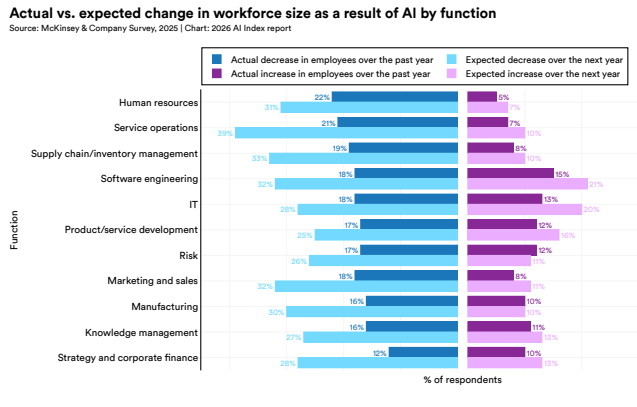
As HR practitioners navigate the many implications of AI for the workplace and the future of work, this newly released report by Stanford's Institute for Human-Centered AI provides one of the most comprehensive independent reviews of AI's trajectory available. While there is much to unpack in this 400+ page report, one topic I want to expand on is AI's impact on early-career employment and what this means for future leadership pipelines. One finding is that early-career workers in AI-exposed roles such as software development and customer support have experienced meaningful employment declines, while mid-career and senior workers in those same roles have held steady or grown. This is an important finding, given that entry-level roles help people build tacit knowledge, judgment, and the leadership capability that senior roles eventually require. Organizations that automate away entry-level positions without rethinking early-career talent strategies are likely to find their leadership pipelines weakening in the years to come. A few weeks back, I pointed out how IBM is taking a different approach, announcing plans to triple its U.S. entry-level hiring in 2026 and redesign junior roles around judgment, oversight, and customer engagement rather than routine tasks that AI now handles. Reflection: How is AI changing early-career roles in your organization? Do you have a strategy for redefining them before the pipeline gap shows up in your leadership bench?

EMPLOYEE EXPERIENCE AND AI
Gallup’s new 2026 edition of its annual global workplace report offers insights on various aspects of employee sentiment and engagement.
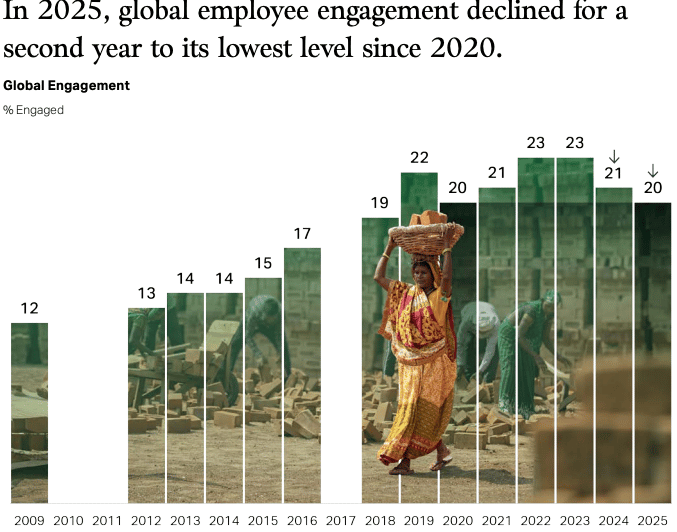
With employee experience being a central focus for many organizations and leaders, the newly released 2026 edition of Gallup’s annual State of the Global Workplace report offers useful insights into employee sentiment. While there are several insights throughout the 251-page report, one notable finding is that manager disengagement is the primary driver behind the 20% drop in employee engagement from its 2023 peak. Manager engagement has declined at nearly three times the rate of employee engagement over the past three years, a shift from the past when managers typically reported higher engagement than individual contributors, whose engagement has remained relatively flat. A second key finding is that managers are also the strongest predictor of AI adoption success in the workplace, even more than technical integration. Employees whose managers actively support AI use are 8.7 times more likely to say their work has been transformed by AI. For HR and talent leaders, one implication is that rebuilding manager engagement is not a separate initiative from driving AI impact, but rather part of the same initiative. Said differently, there are implications for how organizations design AI change management and enablement programs. The report also includes additional insights, including regional breakdowns showing how workplace sentiment varies across geographies.

WORK REDESIGN
A 20-page paper focused on how work redesign in an AI era should start not with the technology, but with one question: what work actually needs to be done?
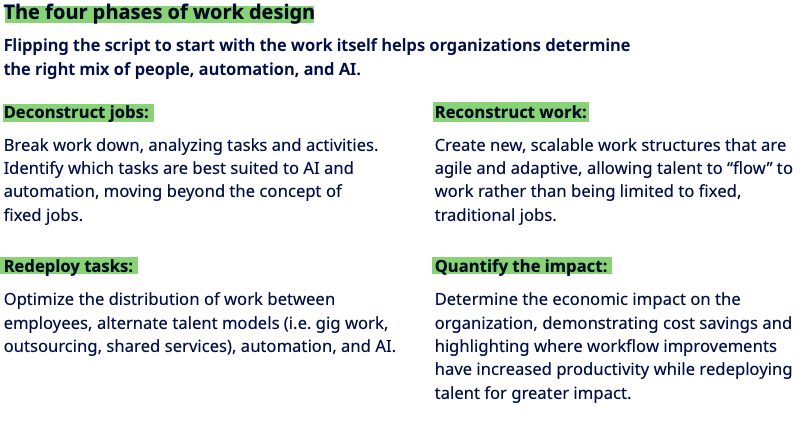
As organizations invest in AI, they must think carefully about how work should be structured, which tasks are best handled by humans, which by technology, which through a combination of both, and how jobs and workflows may need to change. This Mercer paper (a chapter from its 2026 Global Talent Trends report) makes the case that rather than asking how AI and tech can be applied to existing jobs and processes, leaders should start with a more fundamental question: what work actually needs to be done? Mercer then outlines a four-part process: 1) deconstruct work into tasks, 2) redeploy those tasks across people, AI, and automation, 3) reconstruct work into more agile structures, and 4) quantify the impact. One case study illustrates this approach: a global financial services company redesigned a high-impact customer process, with 68 tasks automated, 17 shifted from senior managers to junior employees supported by generative AI, 29 analytical tasks moved to a global capability center, and 14 senior-level tasks being augmented with AI. The distinction matters: when you start with AI or technology, you optimize existing work; when you start with the work itself, you reimagine it. If you're part of Talent Edge Circle, my private community for HR practitioners, you can access our replay and discussion notes from our conversation with Ravin Jesuthasan — futurist and Global Transformation Leader at Mercer and co-author of The Skills-Powered Organization, where we dove deeper into this topic.

TALENT IN CRITICAL ROLES
A few of my slides to help leaders evaluate whether their organization’s top talent is occupying its most critical roles.

I have shared many of my resources to help leaders identify their most critical roles. But identification alone isn't enough. Critical role identification matters to the extent that it informs talent decisions that advance organizational performance. And one of those decisions is ensuring that top talent is deployed in your most critical roles. The rationale is that, since these roles disproportionately impact business outcomes, deploying top talent in them can provide a performance advantage. To help determine if your critical roles are filled by top talent, here are a few of my slides excerpted from my private community, Talent Edge Circle. Each slide highlights one area with a primary question, why it matters, probing questions to dive deeper, and indicators to consider. One example is the internal benchmarking factor, which asks: Could someone inside the organization realistically perform this role significantly better in the near future? Why it matters: helps determine if higher-potential talent exists internally and whether the incumbent is the best fit. Probing questions: Are we keeping this person in the role due to familiarity rather than capability? Indicators to watch out for: internal employees in similar roles are outperforming the incumbent, and high-potential talent is being underutilized. Use this resource as a starting point and modify it to reflect your organization's context as you work to ensure your best talent is in your highest-impact roles.

SUCCESSION PLANNING
My cheat sheet with with eight succession scenarios, each requiring distinct talent actions to keep plans current, relevant, and actionable.
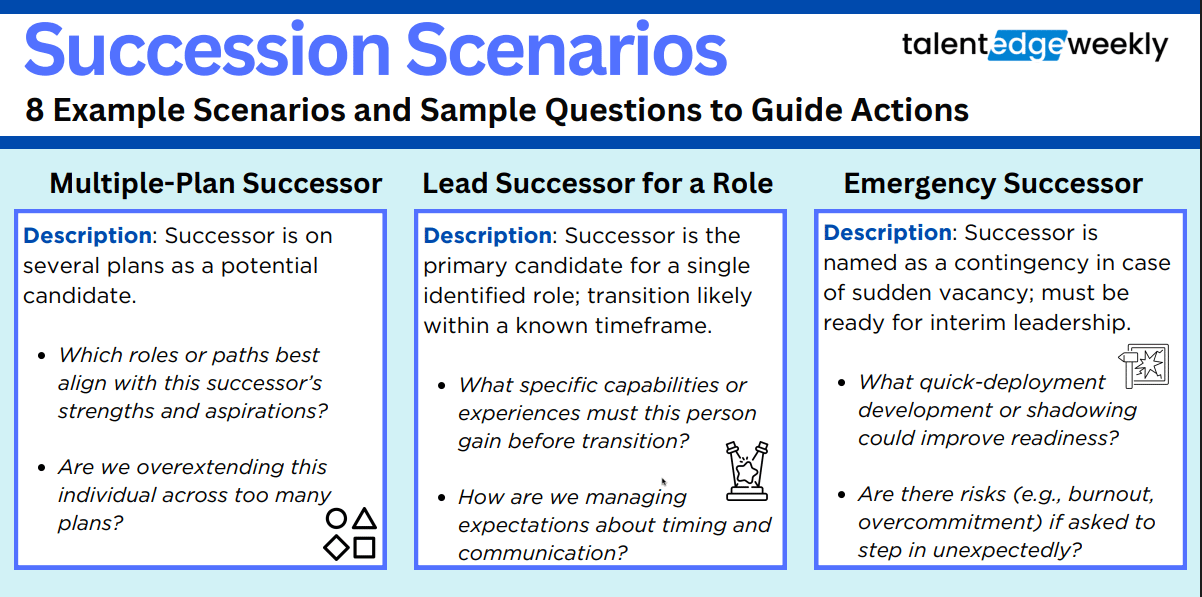
One challenge with succession planning is that after initial successors are identified, different situations often emerge that require adjustments to the original plan. Without ongoing attention, succession plans risk becoming little more than “names on a page” that don’t reflect current reality. What’s needed instead is continuous succession management, where successors are actively developed, reassessed, and supported as circumstances evolve. Here’s my one-page cheat sheet that helps you think through eight succession scenarios that may exist in an organization at any given time. Each scenario is unique and may call for different talent actions informed by the right questions. For a Ready-Now Successor in Waiting (fully ready, but there is a low likelihood the incumbent will vacate the role in the near future), a question to consider is: What is the retention risk if advancement remains delayed? If it is high, what can be done to reduce it? For Declining Successor Readiness (readiness has plateaued or regressed due to performance, engagement, or context changes), ask: What factors contributed to the decline—skill gaps, motivation, or external shifts? Is the role still the right fit, or should we redirect the successor to another opportunity? Questions like this can help prompt ongoing actions rather than waiting until formal succession planning cycles to address them. As a bonus, here is another one of my succession cheat sheets, including information on metrics, trigger events for reassessing succession plans, and more.
MOST POPULAR FROM LAST WEEK
AI DEPLOYMENT
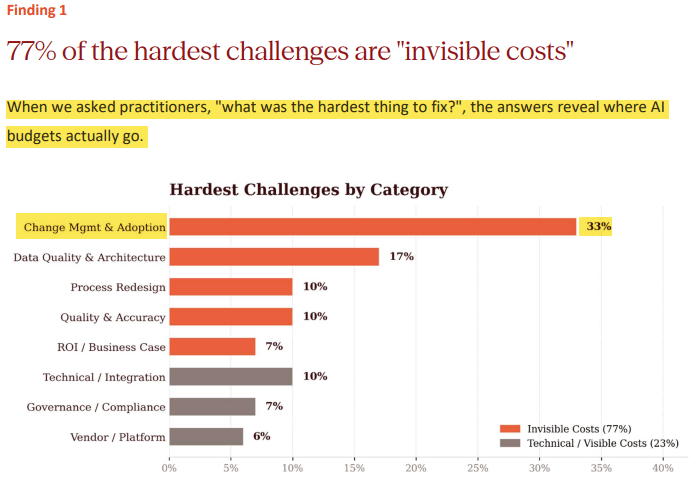
A new 116-page report that draws insights from enterprise AI deployments to identify what separates success from failure.
JOB CUTS AND LAYOFF TRACKER
Check out my tracker of announcements from a segment of organizations that have conducted job cuts and layoffs since the start of 2023.
A few job cuts announced this past week:
British Broadcasting Corporation (BBC). The U.K. national broadcaster plans to eliminate between 1,800 and 2,000 jobs, or roughly 10% of its 21,500-person workforce, to save £500 million over the next two years. The cuts are attributed to inflation, declining license fee income, and commercial pressures. A voluntary reduction will be offered first, with the bulk of the reductions targeted for the fiscal year beginning April 2027.
Snap (NYSE: SNAP). The social media company that owns Snapchat is laying off approximately 1,000 employees, or 16% of its global workforce, as it pivots toward profitable growth. CEO Evan Spiegel cited rapid advances in AI that are enabling smaller teams to do more, with the cuts expected to reduce the company's annualized cost base by more than $500 million by the second half of 2026.
UKG. The HR and workforce management software company is eliminating approximately 950 positions, or 6% of its global workforce, as part of what the company calls its "ongoing transformation." The cuts were communicated on April 15, with around 600 employees leaving immediately and roughly 350 asked to stay on for a transition period. South Florida offices in Sunrise and Weston were among the most heavily affected locations.
CHIEF HR OFFICER MOVE OF THE WEEK
This past week, several new CHRO announcements were posted on CHROs on the Go, my digital platform tracking movement in and out of the CHRO role.
This week’s highlight is:
The Coca-Cola Company (ATLANTA, GEORGIA) [NYSE: KO] — a global total beverage company — announced that Tapaswee Chandele will become Global Chief People Officer, effective May 1, 2026, succeeding Lisa Chang, who is stepping down after a seven-year tenure. Chang will remain with the company through the end of 2026 as a senior advisor and will serve on the board of The Coca-Cola Foundation. Chandele, a 25-year Coca-Cola veteran, most recently served as SVP Chief of Staff to President and CFO John Murphy, a role she held since May 2025. Prior to that, from 2019 to 2025, she served as SVP of Global Talent, Development, and HR System Partnerships. She will report to CEO Henrique Braun.

🔑 To access all detailed CHRO announcements from this past week and over 4,500 archived announcements, join CHROs on the Go. It’s the easiest way to stay informed about movement in and out of the Chief HR role.
If you are already a subscriber to CHROs on the Go, log in here.
TALENT EDGE CIRCLE
👉️ If you’re an internal HR practitioner who wants to go deeper with me and other internal HR practitioners on talent topics tied to your most critical priorities, learn about my private community, Talent Edge Circle.
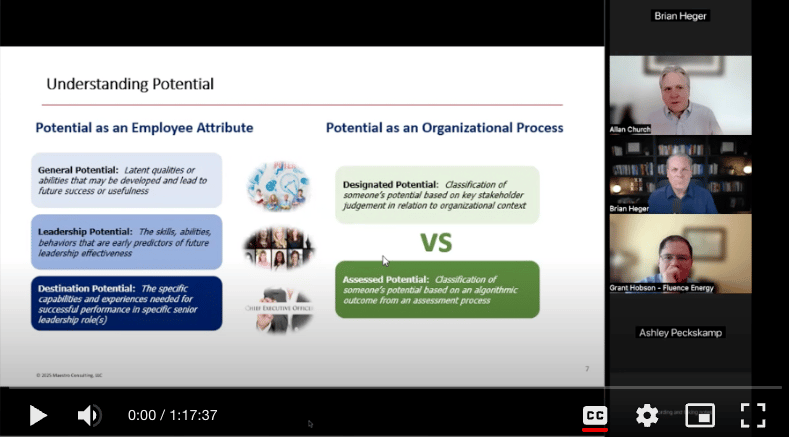
Screenshot from discussion with Allan Church on high potential identification
FROM ME ON LINKEDIN
Catch up on what you may have missed from me on LinkedIn:
THE BEST OF MARCH 2026
Did you miss the “Best of March ” issue of Talent Edge Weekly? If so, check out issue #340, which includes the most popular resources from the month. Thank you to Noota for sponsoring this issue. If your recruiting team is bogged down in operational work, losing valuable time to hire the best talent, get a free trial of Noota’s AI agent for recruiting teams.
Want to get your brand, product, or service in front of our active 57,000+ Talent Edge Weekly subscribers? Learn how to become a potential sponsor.
Talent Edge Weekly is written by Brian Heger, a human resources practitioner. You can connect with Brian on LinkedIn and brianheger.com
🗣️ WANT MORE?
Want access to all my curated resources?
👉️ Visit my website, brianheger.com
Are you an internal HR practitioner?
👉️ Apply for my private, paid community, Talent Edge Circle
Are you a provider of HR-related services?
👉️ Become a sponsor of Talent Edge Weekly
Want to know who’s moving in and out of the CHRO role?
👉️ Join my CHROS on the Go subscription