- Talent Edge Weekly
- Posts
- Talent Edge Weekly - Issue #342
Talent Edge Weekly - Issue #342
Playbook on AI deployments, 12 themes that help organizations scale AI, internal mobility, performance management, and succession planning.

Brian Heger
April 12, 2026

SPONSORED BY

Welcome to this new issue of Talent Edge Weekly!
First, a shout-out to Jim Viola, Chief People Officer at Family Entertainment Group, for referring new subscribers to Talent Edge Weekly. Thank you, Jim, for your support of this newsletter!
PRESENTED BY Vemo
Want to start workforce planning? Build the muscles first.
Many organizations know they need strategic workforce planning—but it’s not always clear where to begin. That’s why we created a practical, muscle-building guide to help you get started.
In this guide, you’ll learn how to:
Identify the workforce roles that shape planning decisions
Build a practical starting point for ongoing workforce planning
Map out potential talent strategies
Define an investment strategy for core roles in your organization
You don’t need a perfect model to start workforce planning. You need to start building the muscle—learning how to assess your organization, understand the capabilities required for performance, and identify where gaps may emerge.
Download the guide and start building your workforce planning muscles today.
P.S. - Want to see how Vemo’s workforce planning platform supports this work? Book a demo
THIS WEEK'S CONTENT
Below are links and descriptions of the topics covered in this issue. If you're interested in my deep dive, you can read the full newsletter.
The Enterprise AI Playbook: Lessons from 51 Successful Deployments | Stanford Digital Economy Lab at Stanford University | A new 116-page report that draws insights from enterprise AI deployments to identify what separates success from failure.
The AI Transformation Manifesto: 12 Themes Driving Growth | QuantumBlack, AI by McKinsey | A new article distills 12 themes that separate companies that are transforming their business with tech and AI from those that are not, drawing from hundreds of large-scale transformations.
Three Tools to Strengthen Internal Mobility in Your Organization | Brian Heger | I share three of my internal mobility cheat sheets to help HR practitioners identify IM gaps, measure progress, and remove barriers.
Are You Overburdening Your Most Engaged Employees? | Harvard Business Review | A new HBR article draws on research published in Organization Science to show how managers often overload their most motivated employees, quietly hurting retention.
Top 5 Corporate Governance Priorities for 2026, With Succession Planning Being Number One | Harvard Law School Forum on Corporate Governance | A new report identifies CEO succession and leadership pipeline strength as the top board governance priority for 2026 and shares why.
Also, check out my job cuts tracker & Chief HR Officer move of the week, which is an excerpt from my CHROs on the Go platform.
TALENT EDGE CIRCLE - Succession Planning
👉️ If you’re part of Talent Edge Circle — my private community for internal HR practitioners — a quick reminder that we have our succession planning discussion this Wednesday 4/15.
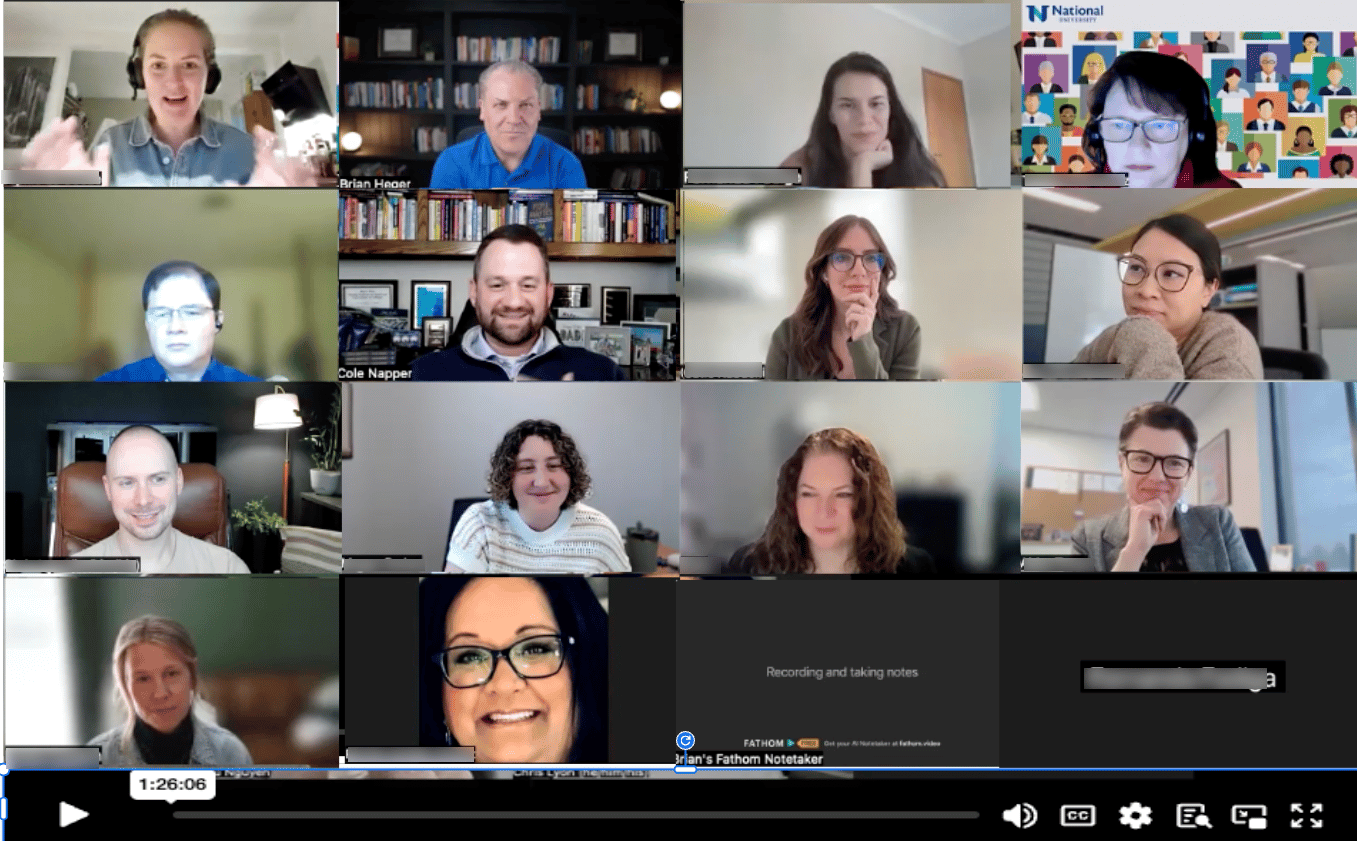
It’s an opportunity to discuss how we’re approaching succession in our organizations, get feedback, and ask questions so we can make faster progress on our succession planning priorities. See you on Wednesday!
⬇️ Now let’s dive in.

THIS WEEK'S EDGE

AI DEPLOYMENT
A new 116-page report that draws insights from enterprise AI deployments to identify what separates success from failure.
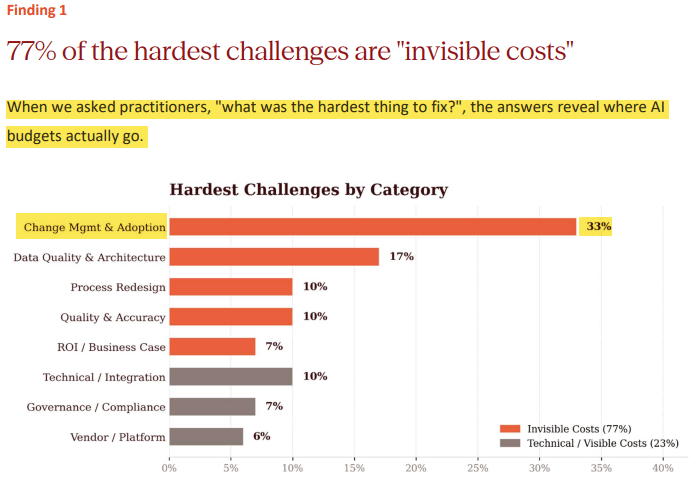
There are many reports and papers on how AI will impact work. But one type of resource that I find especially helpful is hearing from organizations that have deployed AI at scale, the lessons they learned, and guidance for others considering similar efforts. With that as the backdrop, this new 116-page playbook from Stanford's Digital Economy Lab shares practical insights from 51 AI deployments. While there are too many insights to summarize here, one common theme is that an AI deployment’s success or failure was not about the technology, but rather the organization’s readiness, its processes, and its willingness to iterate. One recruiting case study on page 25 illustrates how an AI-enabled recruiting effort failed because leaders assumed AI would fix broken processes. However, the second effort succeeded because the CEO took direct ownership, the process was fixed before applying AI, and the effort stayed focused on the business problem the organization was trying to solve. The results included an 83% improvement in candidate intake efficiency and a 75% improvement in candidate conversion. The playbook also includes cases in customer support, sales, supply chain, clinical care, and more. To reinforce the value of starting with the business problem or opportunity in any HR-supported effort, I am resharing my one-page cheat sheet on the topic.

AI TRANSFORMATION
A new article distills 12 themes that separate companies that are transforming their business with tech and AI from those that are not, drawing from hundreds of large-scale transformations.

As HR practitioners help leaders think through what increases the likelihood of AI transformations succeeding, this new McKinsey article outlines 12 themes separating organizations innovating with AI from those running experiments that never scale. For each theme, it includes a diagnostic question leaders can use to evaluate their efforts. Three themes include: Theme 1: Enduring capabilities over one-off solutions. This helps leaders assess whether they are building repeatable capabilities rather than isolated wins. Diagnostic question: Are you building enduring capabilities for the journey, or merely delivering one-off solutions? Theme 3: If the value you’re creating doesn’t move the business, you’re getting it wrong. This helps leaders assess whether AI efforts are tied to business impact or just incremental gains. Diagnostic question: Will our business transformation plan result in game-changing value, or will the wins be incremental? Theme 9: Design for adoption and build for scale. This helps leaders consider whether the organization can embed and scale AI beyond isolated efforts. Diagnostic question: Can your organization repeatedly adopt and scale AI, or is it still relying on isolated heroics? Together, these themes and diagnostic questions can help HR practitioners guide leaders on where AI investments are most likely to create long-term business value.

INTERNAL MOBILITY
I share three of my internal mobility cheat sheets to help HR practitioners identify IM gaps, measure progress, and remove barriers.

Internal mobility (IM) is rising on the talent agenda as organizations prioritize developing and deploying talent from within. LinkedIn's 2025 LinkedIn Workplace Learning Report finds that even among organizations without mature career development and IM programs, 48% say IM is a higher priority this year. Yet despite this renewed focus, many organizations struggle to move from IM intent to IM execution. To help bridge this gap, here are three of my resources that address different and complementary aspects of IM. The first is my IM Diagnostic, a one-page tool with 20 statements across 10 key areas, such as transparency, manager support, and policy design, to help identify where your organization's IM efforts may be falling short. The second is my IM Metrics cheat sheet, which includes nine example metrics with definitions, rationale, and sample practices to help measure the impact of IM investments. The third is my Barriers to IM cheat sheet, which examines specific policies and non-tech factors, such as restrictive tenure rules and manager resistance, that can hinder talent movement even when organizations have the right intentions. If internal mobility is a focus of yours, this is one of the topics we dive deeper into in my private community for internal HR practitioners, Talent Edge Circle.

PERFORMANCE MANAGEMENT
A new HBR article draws on research published in Organization Science to show how managers often overload their most motivated employees, quietly hurting retention.

I recently shared my post and one-page cheat sheet on goal creep, when new goals are added mid-cycle without recalibrating current priorities or resources. The core point was that when new work is added without adjusting current priorities or available capacity, teams can end up with competing demands that put all objectives at risk. A new Harvard Business Review article from Cornell and Northeastern researchers adds another reason this matters. Drawing from their study just published in Organization Science, the authors highlight how managers often give additional work to employees they see as highly motivated, assuming those employees will welcome it and be less likely to burn out. But that assumption can be wrong. Over time, consistently giving extra work to the most motivated employees can reduce job satisfaction and increase the risk of turnover. My challenge is for both managers and employees to be more intentional: managers about what they assign, and employees about what they agree to take on. Whether the issue is goal creep or workload distribution, my one-page cheat sheet includes six questions to help teams decide whether new work should be taken on, what needs to shift to make room for it, and how it will be resourced.

SUCCESSION PLANNING
A new report identifies CEO succession and leadership pipeline strength as the top board governance priority for 2026 and shares why.

With succession planning a top priority among Talent Edge Weekly readers, I wanted to share this new report published on the Harvard Law School Forum on Corporate Governance and developed by The Conference Board in partnership with Heidrick & Struggles. It identifies CEO succession and leadership pipeline strength as the top board governance priority for 2026. A few stats: more than 11% of S&P 500 CEOs are in the 65–69 age bracket, up from just over 7% in 2017, while the 55 to 59 age group, long seen as a prime succession pool, has dropped from 36% in 2018 to 25% in 2025. In addition, 61% of CEOs and directors expect succession planning to carry more influence on company valuation over the next five years, driven by investor scrutiny of leadership pipeline depth and the signaling value of proactive leadership transitions that demonstrate strategic intent. As a reflection, what narrative are you telling your board about the state of succession planning within your organization? Is it proactive and data-informed or reactive and anecdotal? And does it connect pipeline strength directly to business strategy and long-term value? To spark some of your thinking, I am resharing CEO Succession: 10 Pitfalls Boards Must Avoid and the CHRO Practices That Help by the Center for Executive Succession and the CHRO Association.
MOST POPULAR FROM LAST WEEK
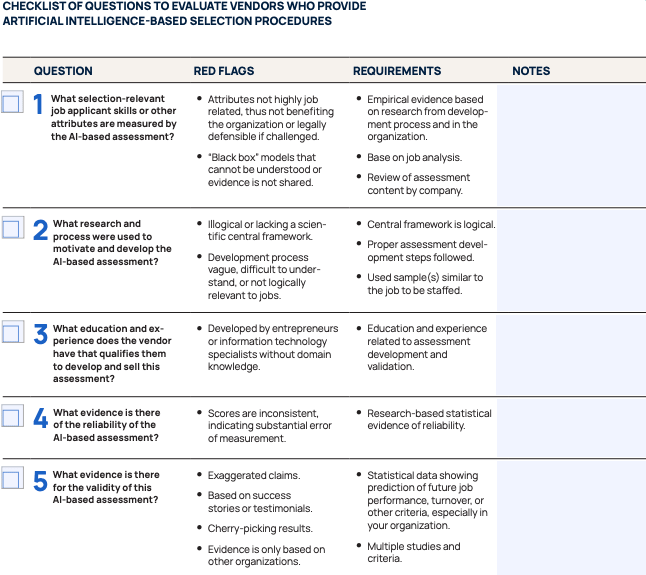
EVALUATING AI-BASED EMPLOYMENT TOOLS
A new guide offering HR practitioners questions to evaluate AI-based employment tools from vendors, covering everything from validity and legal defensibility to data privacy.
JOB CUTS AND LAYOFF TRACKER
Check out my tracker of announcements from a segment of organizations that have conducted job cuts and layoffs since the start of 2023.
A few job cuts announced this past week:
CAE (TSX: CAE). The Montreal-based flight simulator maker and aviation training company is laying off approximately 280 employees, or about 2% of its global workforce, as it braces for reduced spending by commercial airline customers. Nearly two-thirds of the cuts are concentrated in Quebec.
Disney (NYSE: DIS). The media and entertainment giant is planning to lay off up to 1,000 employees, primarily in its marketing department. The cuts follow a consolidation of Disney's marketing operations across film, TV, streaming, and experiences under a single leadership structure, with layoffs expected to begin the week of April 14.
GoPro (NASDAQ: GPRO). The action camera maker plans to lay off approximately 145 employees, or 23% of its global workforce, as part of a restructuring to reduce operating costs and improve profitability. The layoffs are set to begin in the second quarter of 2026 and are expected to largely wrap up by year-end.
CHIEF HR OFFICER MOVE OF THE WEEK
This past week, several new CHRO announcements were posted on CHROs on the Go, my digital platform tracking movement in and out of the CHRO role.

This week’s highlight is:
Comcast (PHILADELPHIA, PA) [NASDAQ: CMCSA] — a global media and technology company — announced the promotion of Vicki Williams to the newly created role of Chief Human Resources Officer, overseeing HR teams and strategy across the company's entire media and cable portfolio, including NBCUniversal and its Connectivity & Platforms business. Williams, who has served as NBCU's head of HR for the past eight years, joined the company in 2011 as SVP of Compensation, Benefits and HR Information Systems.

🔑 To access all detailed CHRO announcements from this past week and over 4,500 archived announcements, join CHROs on the Go. It’s the easiest way to stay informed about movement in and out of the Chief HR role.
If you are already a subscriber to CHROs on the Go, log in here.
TALENT EDGE CIRCLE
👉️ If you’re an internal HR practitioner who wants to go deeper with me and other internal HR practitioners on talent topics tied to your most critical priorities, learn about my private community, Talent Edge Circle.

Screenshot from discussion with Marc Effron on performance management
FROM ME ON LINKEDIN
Catch up on what you may have missed from me on LinkedIn:
THE BEST OF MARCH 2026
Did you miss the “Best of March ” issue of Talent Edge Weekly? If so, check out issue #340, which includes the most popular resources from the month. Thank you to Noota for sponsoring this issue. If your recruiting team is bogged down in operational work, losing valuable time to hire the best talent, get a free trial of Noota’s AI agent for recruiting teams.
Want to get your brand, product, or service in front of our active 57,000+ Talent Edge Weekly subscribers? Learn how to become a potential sponsor.
Talent Edge Weekly is written by Brian Heger, a human resources practitioner. You can connect with Brian on LinkedIn and brianheger.com
🗣️ WANT MORE?
Want access to all my curated resources?
👉️ Visit my website, brianheger.com
Are you an internal HR practitioner?
👉️ Apply for my private, paid community, Talent Edge Circle
Are you a provider of HR-related services?
👉️ Become a sponsor of Talent Edge Weekly
Want to know who’s moving in and out of the CHRO role?
👉️ Join my CHROS on the Go subscription