- Talent Edge Weekly
- Posts
- Talent Edge Weekly - Issue #341
Talent Edge Weekly - Issue #341
Performance management cheat sheets, pathways to the Chief HR Officer role, accelerating talent initiatives, evaluating AI-based employment tools, and the impact of AI on jobs and how to prepare.

Brian Heger
April 05, 2026

SPONSORED BY

Welcome to this new issue of Talent Edge Weekly!
First, a shout-out to Bill Agostini, Sr. Director, Talent Management & OD at Veolia North America, for referring new subscribers to Talent Edge Weekly. Thank you, Bill, for your support of this newsletter!
PRESENTED BY Lightcast
Your Workforce Strategy Isn’t Broken. It’s Based on a Fiction
Most workforce strategies still assume talent is predictable: pipelines can be built, roles evolve gradually, and supply will meet demand with enough planning. That logic no longer holds. Clinging to it is quickly becoming a liability.
Three forces are colliding to dismantle those assumptions.
Talent pools are being redrawn by geopolitics.
AI is rapidly redefining what “qualified” means.
And demographic shifts are tightening supply in ways traditional planning cannot absorb.
These are not trends to monitor. They are structural constraints that compound each other.
The implication is stark. Workforce planning, as most organizations practice it, is no longer forward looking. It is a rearview mirror. The risk is not being unprepared for the future. It is confidently investing in a model that cannot adapt to it.
The organizations pulling ahead are not refining old approaches. They are abandoning core assumptions about how talent works.
Download Lightcast’s Fault Lines report to see what they are doing differently and why it matters now.
THIS WEEK'S CONTENT
Below are links and descriptions of the topics covered in this issue. If you're interested in my deep dive, you can read the full newsletter.
The Year Is Moving Fast: Three Cheat Sheets to Strengthen Performance and Goal Execution Through Year-End | Brian Heger | I share three of my cheat sheets to help leaders prevent goal creep, address ways of working that may undermine execution, and realign resources to drive results.
Chief People Officer Pathways Report | EtonBridge Partners | A new 28-page report analyzing nearly 15,000 global CPO appointments between 2023 and 2025 highlights how the pathway to the top HR role is shifting.
Moving Talent Initiatives Forward: A Business Case and Implementation Plan for Action | Brian Heger | I share two of my slides using workforce planning as an example to show how pairing a clear business case with a practical phased implementation plan can help move talent work into action.
How to Evaluate Artificial Intelligence (AI) Based Employment Tools from Vendors | CHRO Association and SIOP Foundation | A new guide offering HR practitioners questions to evaluate AI-based employment tools from vendors, covering everything from validity and legal defensibility to data privacy.
AI Will Reshape More Jobs Than It Replaces | BCG Henderson Institute | A new 21-page report examining how AI will reshape jobs using a 6-category framework, with implications for talent strategy.
Also, check out my job cuts tracker & Chief HR Officer move of the week, which is an excerpt from my CHROs on the Go platform.
TALENT EDGE CIRCLE
👉️ If you’re a member of Talent Edge Circle — my private community for internal HR practitioners —I’m looking forward to having Dave Ulrich join us for an upcoming practical discussion on creating stakeholder value in HR. Learn more about Talent Edge Circle.
I also highly recommend checking out Dave’s, along with his colleagues’, Global HR Leadership Experience (GHRLE)—a 100-day immersive program designed to develop the next generation of HR leaders with insights from world-class CHROs, global HR association leaders, and leading scholars. The Spring 2026 cohort begins April 27 at the Darla Moore School of Business, with in-person sessions through May 5 and virtual engagement continuing through June 2026. Learn more about GHRLE. |

⬇️ Now let’s dive in.

THIS WEEK'S EDGE

PERFORMANCE MANAGEMENT
I share three of my cheat sheets to help leaders prevent goal creep, address ways of working that may undermine execution, and realign resources to drive results.

We are now into the first week of April, and roughly one-quarter of the year has already passed. Even with the year already well underway, there is still time to influence and accelerate critical organizational goals and priorities for the rest of the year. To do that, however, organizations need to be intentional about how they prioritize, support, and execute those goals. Without that discipline, what may feel like an ample window to deliver results can narrow quickly as the year progresses. To support that execution, I am resharing three of my one-page cheat sheets. The first provides six questions leaders can use to critically evaluate whether new goals or requests should be prioritized and what trade-offs may be needed to prevent goal creep. The second helps teams identify ways of working that might get in the way of goal execution, such as slow decisions, unclear ownership, or too many approval layers. The third helps leaders evaluate where projects, budget, and talent may need to shift so that the most important priorities are properly resourced. Simple tools like these can help managers and leaders make faster, better decisions in real time and use performance management as an enabler of business strategy execution and organizational performance.

CHIEF HR OFFICER
A new 28-page report analyzing nearly 15,000 global CPO appointments between 2023 and 2025 highlights how the pathway to the top HR role is shifting.
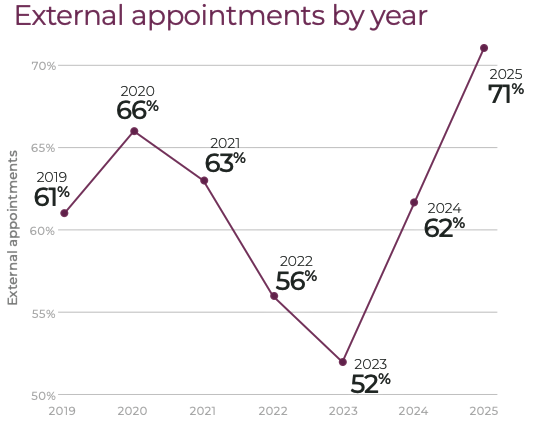
Since 2021, I have tracked and reported on thousands of hires, promotions, and exits in the Chief HR Officer (CHRO) and Chief People Officer (CPO) roles through CHROs on the Go, my subscription-based platform tracking movement in and out of the top HR leadership role. Over that time, one pattern worth watching is how the mix of internal and external appointments shifts from year to year, and what that may signal about HR leadership pipeline strength at any given time. A new 28-page report from EtonBridge Partners puts data behind that trend. Analyzing nearly 15,000 global CHRO and CPO appointments between 2023 and 2025, the report shows that external appointments rose from 52% in 2023 to 71% in 2025, reversing a multi-year trend toward internal promotion. First-time CPO appointments are also rising, especially in private equity-backed environments, where nearly 40% of appointments now occur. For current CHROs, the data raises useful questions: Who are you actively developing for the top HR role? Are they getting the business exposure needed to be credible candidates? And if the role opened unexpectedly, would you truly appoint one of them? Why or why not? If any of these answers are unclear, that should be a signal to take a harder look at the strength of your succession pipeline. For one of the easiest ways to stay current on CHRO and CPO movement, join CHROs on the Go.

HR IMPACT
I share two of my slides using workforce planning as an example to show how pairing a clear business case with a practical phased implementation plan can help move talent work into action.
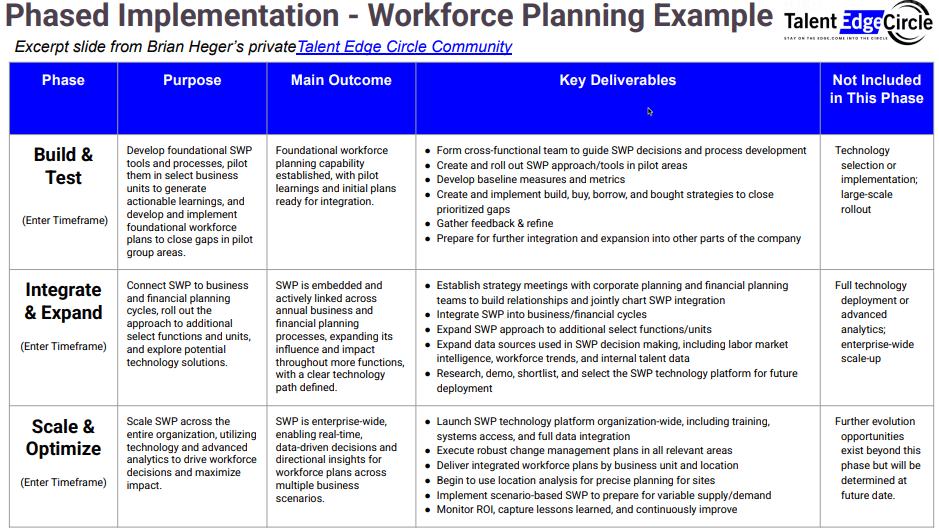
I recently shared the 2026 Creating People Advantage report by BCG and WFPMA , which assessed 28 people and talent practices ranging from workforce planning and succession planning to performance management. Drawing on input from more than 7,000 HR and business leaders, the report examined the gap between future importance and current capability across those practices. Workforce planning ranked #4 among the largest gaps. One reason I believe gaps like this persist across HR is that it can be easy to delay action while waiting for the perfect plan, perfect data, perfect technology, or perfect conditions before getting started. When that happens, the gap is likely to widen and opportunities to accelerate business strategy execution and create stakeholder value through HR may be missed. One way to break that pattern is to pair a clear one-page business case with a second one-pager showing a practical phased implementation plan. I am sharing both using workforce planning as the example. Regardless of the talent work or initiative you are trying to move forward, use these resources to organize your thinking, identify next steps, and build momentum toward action. These are the types of practical topics and tactics we discuss in Talent Edge Circle, my private community for internal HR practitioners.

AI IN HR
A new guide offering HR practitioners questions to evaluate AI-based employment tools from vendors, covering everything from validity and legal defensibility to data privacy.
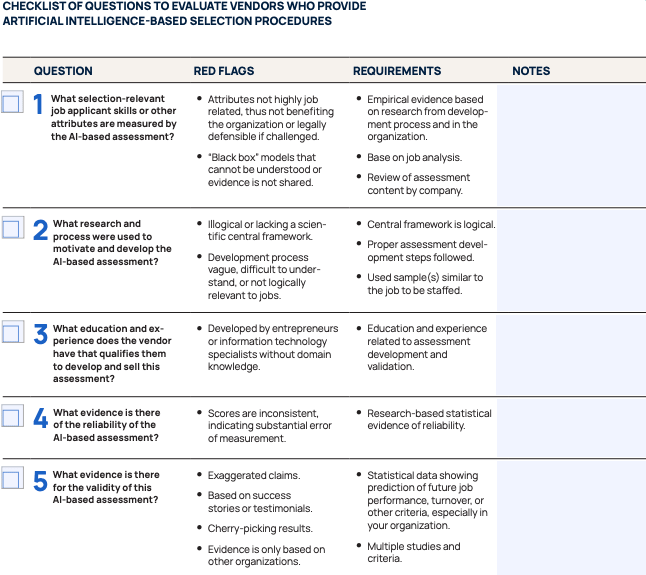
As more AI-based employment tools enter the market, one challenge many HR practitioners face is knowing how to properly evaluate what vendors are actually selling. A new guide from the SIOP Foundation (Society for Industrial and Organizational Psychology) and the CHRO Association addresses this directly. The guide makes clear that these purchasing decisions deserve rigorous and ongoing evaluation, not a one-time review. The guide provides 13 questions that move organizations beyond vendor claims and peer benchmarking toward a more rigorous assessment of AI-enabled employment tools. One example: the guide asks how the tool was developed and whether the validation sample reflects actual job contexts, not convenience samples pulled from paid online survey panels with no connection to real hiring situations, which is a specific red flag the guide calls out. While the questions are primarily focused on employee selection, they can also be applied more broadly when AI is being considered for other areas of HR. Whether you are evaluating AI-based platforms you are considering for purchase or auditing the ones you currently have in place, these questions provide a practical level of rigor that helps make better investment decisions that tap the benefits of these tools while mitigating the risks.

AI AND SKILLS
A new 21-page report examining how AI will reshape jobs using a 6-category framework, with implications for talent strategy.
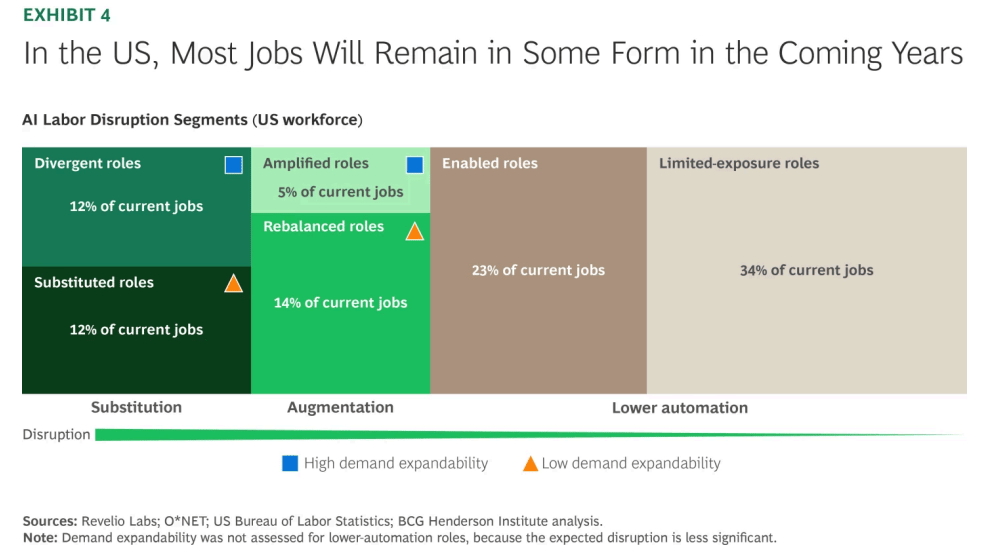
This new 21-page BCG Henderson Institute report shares insights from an analysis of approximately 165 million U.S. jobs, finding that 50% to 55% will be substantially changed by AI over the next two to three years. Rather than predicting broad job losses, the report organizes roles into six categories, including Divergent Roles (12%), where AI takes on more structured work while senior roles grow and junior roles shrink; Substituted Roles (12%), where AI handles more core work directly and fewer people are needed; and Rebalanced Roles (14%), where work shifts toward higher-value activities. For HR practitioners, these findings can help think through implications across several areas of talent strategy. In workforce planning, this can help identify where role redesign, redeployment, succession depth, and headcount shifts may be needed. In talent acquisition, it can help leaders adjust hiring plans and protect early-career pathways that build future talent pipelines. In talent development, it highlights where ongoing reskilling and upskilling may be most urgent as work changes within roles. These are just a few of the implications. I encourage you to read the full report, review each of the six role categories, and consider what they may mean for talent strategy and the underlying HR and talent practices that enable it.
MOST POPULAR FROM LAST WEEK
FUTURE OF WORK
A 79-page report explores issues shaping the future of work, workforce, and workplace.

JOB CUTS AND LAYOFF TRACKER
Check out my tracker of announcements from a segment of organizations that have conducted job cuts and layoffs since the start of 2023.
A few job cuts announced this past week:
Electrolux Group (OTCMKTS: ELUXY). The Swedish home appliance manufacturer announced it will close its factory in Santiago, Chile, affecting approximately 400 employees. The decision follows a cost competitiveness review of the facility, with the closure effective at the end of April 2026; Electrolux will continue serving the Chilean market through products sourced from other factories and external partners.
Fujitsu (OTCMKTS: FJTSY). The IT services company announced a voluntary redundancy program targeting approximately 270 jobs in the UK — nearly 10% of its UK workforce — as part of a broader strategic transformation. The cuts come as Fujitsu continues to lose public and private sector business in the UK. Involuntary reductions may follow if voluntary targets are not met.
Oracle (NYSE: ORCL). The enterprise software and cloud company began laying off an estimated 20,000 to 30,000 employees globally — roughly 18% of its workforce — as it redirects capital toward AI data center expansion. Employees in the US, India, Canada, and Mexico received termination notices via email on March 31.
CHIEF HR OFFICER MOVE OF THE WEEK
This past week, several new CHRO announcements were posted on CHROs on the Go, my digital platform tracking movement in and out of the CHRO role.

This week’s highlight is:
Intel (SANTA CLARA, CALIFORNIA) [NASDAQ: INTC]— a global semiconductor company that designs and manufactures advanced semiconductors—announced the appointment of Aparna Bawa as EVP and Chief Legal & People Officer, effective May 2026. Bawa joins from Zoom, where she served as Chief Operating Officer, overseeing operational, legal, and people functions during a period of rapid growth and global scale. In her new role, she will lead Intel's global legal, ethics, compliance, people, and culture organizations, reporting directly to CEO Lip-Bu Tan.

🔑 To access all detailed CHRO announcements from this past week and over 4,500 archived announcements, join CHROs on the Go. It’s the easiest way to stay informed about movement in and out of the Chief HR role.
If you are already a subscriber to CHROs on the Go, log in here.
TALENT EDGE CIRCLE
👉️ If you’re an internal HR practitioner who wants to go deeper with me and other internal HR practitioners on talent topics tied to your most critical priorities, learn about my private community, Talent Edge Circle.
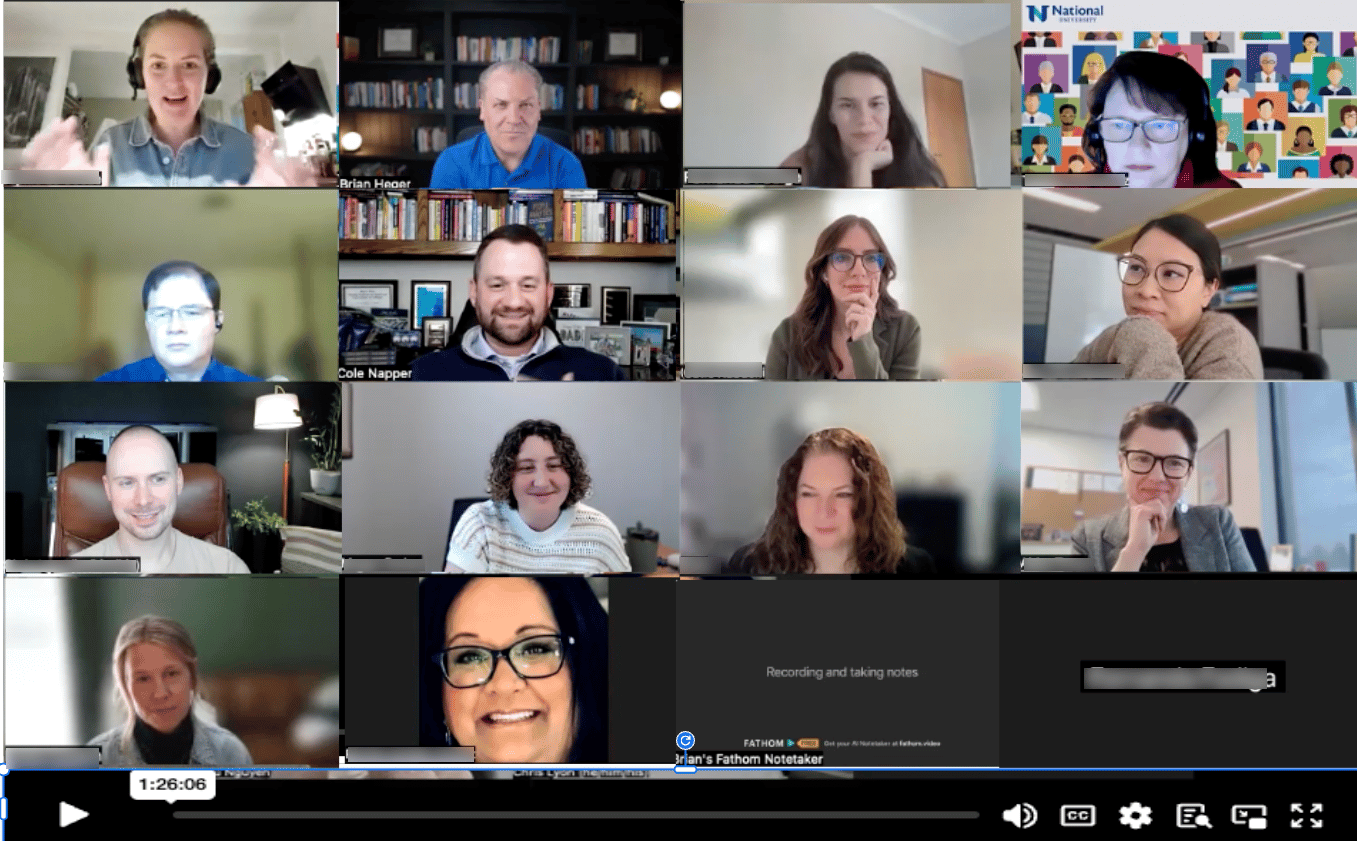
Screenshot of recent discussion with Cole Napper on Data-driven HR
FROM ME ON LINKEDIN
Catch up on what you may have missed from me on LinkedIn:
THE BEST OF MARCH 2026
Did you miss the “Best of March ” issue of Talent Edge Weekly? If so, check out issue #340, which includes the most popular resources from the month. Thank you to Noota for sponsoring this issue. If your recruiting team is bogged down in operational work, losing valuable time to hire the best talent, get a free trial of Noota’s AI agent for recruiting teams.
Want to get your brand, product, or service in front of our active 57,000+ Talent Edge Weekly subscribers? Learn how to become a potential sponsor.
Talent Edge Weekly is written by Brian Heger, a human resources practitioner. You can connect with Brian on LinkedIn and brianheger.com
🗣️ WANT MORE?
Want access to all my curated resources?
👉️ Visit my website, brianheger.com
Are you an internal HR practitioner?
👉️ Apply for my private, paid community, Talent Edge Circle
Are you a provider of HR-related services?
👉️ Become a sponsor of Talent Edge Weekly
Want to know who’s moving in and out of the CHRO role?
👉️ Join my CHROS on the Go subscription