- Talent Edge Weekly
- Posts
- Talent Edge Weekly - Issue #329
Talent Edge Weekly - Issue #329
2026 objectives and ways of working, using business triggers to anticipate workforce shifts, scenario planning, how AI continues to shape the future of work, and skills-first talent practices.

Brian Heger
January 04, 2026

SPONSORED BY

Happy New Year, and welcome to this issue of Talent Edge Weekly!
First, a shout-out to Bridget Penney, Chief People Officer at Applied Systems, for referring new subscribers to Talent Edge Weekly. Thank you, Bridget, for your support of this newsletter!
PRESENTED BY Draup
As organizations pivot toward skills-based strategies in workforce planning, hiring, and internal mobility, the missing link remains a scalable, intelligent skills architecture—one that goes beyond surface-level role definitions.
Draup’s AI-powered Skills Architecture addresses this need head-on. It breaks down roles into root skills, core competencies, and associated tech stacks.
Built on over 850 million job descriptions, 50k products in Tech Stack, and a taxonomy of 17,500+ curated skills, our model allows organizations to:
Surface hidden capability gaps across business units
Anticipate the next wave of skill evolution
Orchestrate targeted, skill-first talent interventions
If your organization is serious about embedding a skills-based approach at scale, download Draup’s Skills Architecture report to see what’s possible.
Want to get your brand, product, or service in front of our active 55,000+ Talent Edge Weekly subscribers? Learn how to become a potential sponsor.
THIS WEEK'S CONTENT
Below are links and descriptions of the topics covered in this issue. If you're interested in my deep dive, you can read the full newsletter.
2026 Objectives Setting is Underway. Will Your Ways of Working Enable the Performance Outcome? | Brian Heger | My cheat sheet to help teams assess if their current ways of working will enable 2026 performance objectives.
Using Business Triggers to Anticipate Talent and Workforce Shifts | Brian Heger | My cheat sheet helps leaders identify business triggers that serve as leading indicators of when talent strategy adjustments may be needed.
Assess What Is Certain in a Sea of Unknowns | MIT Sloan Management Review | Shares how scenario planning can be augmented by also clarifying certainties rather than just uncertainties.
Microsoft New Future of Work Report 2025 | Microsoft’s New Future of Work Initiative | A recent 74-page report provides research-backed insights from multiple sources on how AI is shaping work.
Skills-First: Policy and Impact | Institute for Adult Learning Singapore | A new 52-page working paper providing insights into how skills-first principles are being put into practice across policy design, implementation, and impact.
Also, check out my job cuts tracker & Chief HR Officer move of the week, which is an excerpt from my CHROs on the Go platform, where I track hires, promotions, and exits in the Chief HR Officer role.
👉️ And don’t forget to catch up on what you may have missed from the Best of December Issue 328 of Talent Edge Weekly! 👈️
⬇️ Now let’s dive in!

THIS WEEK'S EDGE

ORGANIZATIONAL EFFECTIVENESS
My cheat sheet to help teams assess if their current ways of working will enable 2026 performance objectives.

As the new year gets underway, many organizations are developing, refining, or beginning to implement their 2026 objectives. While much time is spent aligning on goals, defining metrics and KPIs, and refining the performance management process, less attention is often given to the ways of working that enable or hinder the achievement of those objectives. For example, an organization may set a clear objective to accelerate product delivery, yet slow decision-making, unclear ownership across functions, or excessive approval layers can erode progress long before performance metrics reveal a problem. Put differently, you can have the right objectives and the right people focused on them, yet it is often the ways of working that ultimately determine whether objectives translate into the desired performance outcomes. To surface these issues early, I created a one-page cheat sheet that leaders and their teams can use to identify which current ways of working could detract from goal achievement if left unaddressed. It is anchored in a simple but powerful question: “If we were to fast-forward to the end of 2026 and see that we fell short of this objective, which ways of working would we say got in our own way and contributed most to that result?” From there, teams identify two to three actions they can take immediately to reduce the likelihood of that outcome. Early action matters because once results are off track, the window to materially change performance outcomes narrows quickly. Take this action now to turn ways of working into an execution advantage rather than a performance risk.

TALENT STRATEGY
My cheat sheet helps leaders identify business triggers that serve as leading indicators of when talent strategy adjustments may be needed.
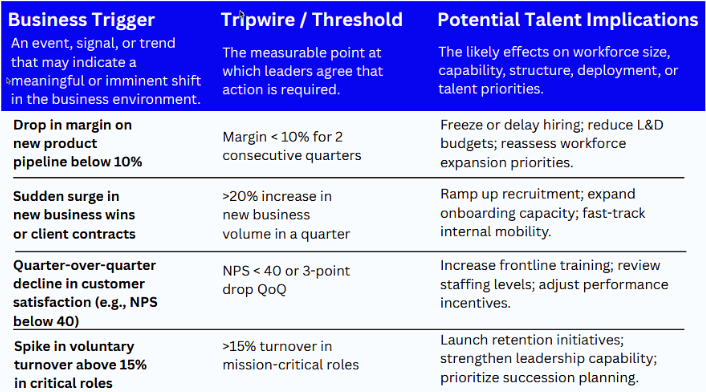
I recently shared my cheat sheet with 12 examples of talent tactics that might underpin a talent strategy, ranging from talent redeployment and automation to upskilling, along with guidance on when each tactic works well or not and examples in practice. But once strategies are set, business conditions often shift throughout the year, requiring reassessment of whether talent strategies still align with the business. To support those discussions, I’m sharing a one-page PDF I developed. The first column provides examples of Business triggers (events, signals, or trends indicating a meaningful or imminent shift in the business environment), followed by Tripwires or Thresholds (the measurable point at which leaders agree action is required), and Talent implications (likely effects on workforce size, capability, structure, deployment, or priorities). For example, a surge in new business wins (business trigger) and a more than 20 percent quarterly increase in volume (tripwire/threshold) may prompt talent implications such as ramping up recruitment, expanding onboarding capacity, or fast-tracking internal mobility. The 9 examples on my cheat sheet are intended to spark initial thinking rather than serve as a prescriptive list; teams should focus on identifying triggers most relevant to their own context. The goal is to envision possible business scenarios and talent responses so teams can adjust confidently as conditions evolve. For members of my private community for internal HR practitioners, Talent Edge Circle, our resource library includes additional pages to this document to help you identify triggers for your organization, along with a worksheet to document your thinking.

SCENARIO PLANNING
Shares how scenario planning can be augmented by also clarifying certainties rather than just uncertainties.

As noted in Deloitte Insights’ recent article, Six Workforce Strategies to Plan for a Future You Can’t Predict, scenario planning remains an important tool for building more flexible workforce plans. I’ve also shared several resources, including this cheat sheet, which I’ve created on how scenario planning can enable a more fluid and agile approach to workforce and talent planning. While scenario planning helps leaders and their teams prepare for uncertainty, there is something equally critical that often gets overlooked: what is knowable about the future. In this article, Cynthia Selin argues that a stronger strategy doesn’t come from imagining endless possibilities, but from explicitly identifying the certainties, enduring realities, and forces already shaping what is possible. Practically, this means grounding workforce and talent planning in what is relatively stable before exploring what might change, allowing leaders to better prioritize talent investments and make smarter workforce decisions. To make this practical and simple to start applying, one question to consider is: What elements of our workforce planning would persist across multiple future scenarios? This matters because it helps teams see which workforce decisions apply across multiple futures and which should remain flexible as conditions change. As a bonus, I am sharing one of my templates, which helps to identify a base scenario (what we expect will occur and plan for) alongside alternate scenarios.

FUTURE OF WORK WITH AI
A recent 74-page report provides research-backed insights from multiple sources on how AI is shaping work.

This recently released 74-page report by Microsoft’s New Future of Work Initiative provides research-backed insights from multiple sources on how AI is shaping, and has the potential to shape, work. It examines six core areas: 1) Adoption and Usage, including adoption patterns, key drivers, challenges, and gaps; 2) Impact on Work and Labor Markets, covering productivity, job evolution, employment and wages, where agents may reshape markets, and the roles of automation and augmentation; 3) Human–AI Collaboration, exploring how interactions with AI are changing and how collaboration can be improved across modalities and time frames; 4) AI for Teamwork, focusing on how AI can support teams and be effectively integrated into group workflows; 5) Thinking, Learning, and Psychological Influences, considering impacts on cognition, learning, and well-being, and whether AI can make people smarter, not just more productive; and 6) Specific Roles and Industries, detailing how AI is changing work for software engineers, program managers, researchers, and others. While there are too many insights to cover here, the section beginning on page 22 within Impact on Work and Labor Markets highlights that as AI advances, human judgment becomes increasingly critical, particularly in recognizing improvement opportunities and choosing the right actions under ambiguity, areas tied to context, ethics, and creativity where AI still struggles. With this in mind, I am resharing a December 2025 World Economic Forum report, New Economy Skills: Unlocking the Human Advantage, which outlines the human-centric skills that will remain essential in an AI-enabled world.

SKILLS
A new 52-page working paper providing insights into how skills-first principles are being put into practice across policy design, implementation, and impact.

This new 52-page working paper provides insights into how skills-first principles are being put into practice across policy design, implementation, and impact. While the report includes many useful insights, section six, beginning on page 30, features visual tables that outline what it takes to move from readiness to adoption across different aspects of skills-first practices. The section assesses three dimensions: Prerequisites (what is required to enable the capability), Coordination (the level of effort needed to mobilize the capability), and Capability maturity (the overall level required to achieve meaningful impact). For example, for Skills Validation Infrastructure, prerequisites include an established, frequently updated national jobs-skills-tasks taxonomy and clear regulatory frameworks to build employer confidence in digital credentials. Coordination requirements are high, involving sector agencies, industry partners, and training providers working together to build and sustain sectoral or occupational skills validation infrastructure and supporting regulation. Capability requirements are also high, as a robust skills validation system must be professionally managed with strong assessment, quality assurance, and data management. Beyond the specific framework presented in the paper, practitioners can apply a similar approach to clarify what is needed to advance their own skills-first initiatives. As a bonus, I am resharing a popular resource, the Skills-Based Internal Mobility Playbook by the Business Roundtable, which addresses several aspects of skills-based practices.
MOST POPULAR FROM LAST ISSUE
HR’S BUSINESS IMPACT
An excerpt slide from my private Talent Edge Circle community that shows an example of how year-end HR results contribute to various business outcomes.

As many HR leaders and their teams begin summarizing the outcomes they delivered this year, it is impactful to organize accomplishments by the business results they enabled rather than simply listing activities completed. Learn more about Talent Edge Circle.
JOB CUTS AND LAYOFF TRACKER
Check out my tracker of announcements from a segment of organizations that have conducted job cuts and layoffs since the start of 2023.
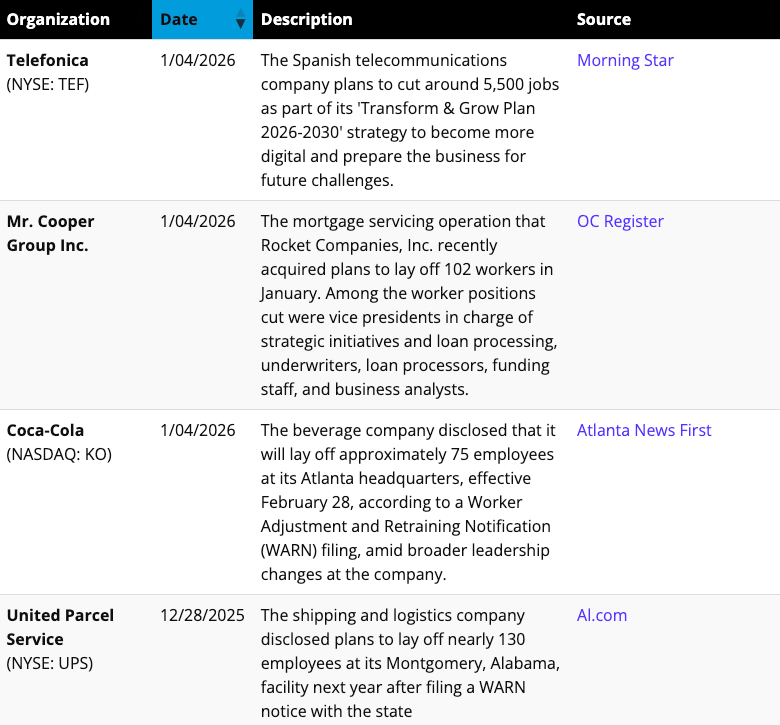
Partial view of my job cuts tracker on brianheger.com
A few job cuts announced this past week:
Coca-Cola (NYSE: KO). The beverage company disclosed that it will lay off approximately 75 employees at its Atlanta headquarters, effective February 28, according to a Worker Adjustment and Retraining Notification (WARN) filing, amid broader leadership changes at the company.
Mr. Cooper Group Inc. (NYSE: RKT). The mortgage servicing operation that Rocket Companies, Inc. recently acquired plans to lay off 102 workers in January. Among the worker positions cut were vice presidents in charge of strategic initiatives and loan processing, underwriters, loan processors, funding staff, and business analysts.
Telefonica (NYSE: TEF). The Spanish telecommunications company plans to cut around 5,500 jobs as part of its 'Transform & Grow Plan 2026-2030' strategy to become more digital and prepare the business for future challenges.
CHIEF HR OFFICER MOVE OF THE WEEK
This past week, several new CHRO announcements were posted on CHROs on the Go, my subscription platform tracking movement in and out of the CHRO role. This week’s CHRO move of the week is:
Oshkosh Corporation (OSHKOSH, WISCONSIN) [NYSE: OSK]—a leading innovator of purpose-built vehicles, equipment and services—announced the appointment of Jackie Nystrom as Chief Human Resources Officer, effective January 1, 2026. In her most recent position, Jackie served as VP of HR for Oshkosh's Vocational segment, supporting a global workforce of 7,500 team members.

👉️ To access all detailed CHRO announcements from this past week and over 4,500 archived announcements, join CHROs on the Go.
If you are already a subscriber to CHROs on the Go, log in here.
FROM ME ON LINKEDIN
Catch up on what you may have missed from me on LinkedIn:
THE BEST OF DECEMBER 2025
PRESENTED BY

Did you miss the “Best of December ” issue of Talent Edge Weekly? If so, check out issue #328, which includes the most popular resources from the month.
PRESENTED BY Talent Edge Circle
As an internal HR practitioner, you don’t have to do this work alone.
Talent Edge Circle is my private, application-based community for internal HR practitioners.
It’s an intentionally curated community and led by me, bringing together practitioners in similar roles and at similar levels who share common priorities and challenges. This keeps the focus on the work that matters most.
You’ve been supporting everyone else. Now it’s your turn to get the support you need. Apply today to start the new year with greater clarity and confidence.
Want to get your brand, product, or service in front of our active 55,000+ Talent Edge Weekly subscribers? Learn how to become a potential sponsor.
Talent Edge Weekly is written by Brian Heger, a human resources practitioner. You can connect with Brian on LinkedIn and brianheger.com
🗣️ WANT MORE?
Want access to all my curated resources?
👉️ Visit my website, brianheger.com
Are you an internal HR practitioner?
👉️ Apply for my private, paid community, Talent Edge Circle
Are you a provider of HR-related services?
👉️ Become a sponsor of Talent Edge Weekly
Want to know who’s moving in and out of the CHRO role?
👉️ Join my CHROS on the Go subscription