- Talent Edge Weekly
- Posts
- Talent Edge Weekly - Issue #326
Talent Edge Weekly - Issue #326
12 talent strategy tactics, AI-enabled workforce planning, a new report on skills, questions to determine if a vacant role should be filled, and AI adoption in the workplace.

Brian Heger
December 07, 2025

SPONSORED BY

Welcome to this issue of Talent Edge Weekly!
A shout-out to Bridget Marlowe, Sr. Director, Human Resources at Neurogene, Inc., for referring new subscribers to Talent Edge Weekly. Thank you, Bridget, for your support of this newsletter!
PRESENTED BY i4cp
Work is being rewritten. What’s coming next for HR in 2026?
i4cp’s 2026 Priorities & Predictions report provides a look at the coming year through the distinct perspective of CHROs and senior leaders across talent, learning, talent acquisition, impact & belonging, total rewards, people analytics, and the future of work to identify the forces that will shape the year ahead.
Read what they say HR leaders should be prepared for in 2026.
You will discover:
4 predictions that will redefine the HR profession in 2026
Top priorities of CHROs and other functional leaders
Strategic moves to stay ahead in a year of transformation
Join i4cp’s 2026 Priorities & Predictions webinar on Jan 15 at 1pm ET, when i4cp’s Founder and Chief Strategy Officer Kevin Oakes and Chief Research Officer Kevin Martin, will take a deeper dive into the insights shared in the report.
Want to get your brand, product, or service in front of our active 55,000+ Talent Edge Weekly subscribers? Learn how to become a potential sponsor.
THIS WEEK'S CONTENT
Below are links and descriptions of the topics covered in this issue. If you're interested in my deep dive, you can read the full newsletter.
Talent Strategy Mix: 12 Examples of Tactics | Brian Heger | My cheat sheet with 12 talent tactics that help organizations determine when each approach works well, when it doesn’t, and examples of them in practice.
Agentic AI Isn’t Just Joining the Workforce. It’s Reshaping how Organizations Plan for It | Deloitte Insights | Explores how agentic AI can transform workforce planning into an adaptive, real-time discipline that helps organizations respond more effectively to changing workforce needs.
New Economy Skills: Unlocking the Human Advantage | World Economic Forum | A new 39-page white paper provides guidance on skills that should be prioritized to ensure organizations have the talent to deliver on innovation, resilience, and growth priorities.
Eight Sample Questions to Help Determine If a Vacant Role Needs to be Filled | Brian Heger | My cheat sheet with questions to help leaders decide whether to backfill vacant roles, reducing the costly cycle of overhiring.
Accountable Acceleration: Gen AI Fast-Tracks Into the Enterprise | Wharton Human-AI Research | A recently released 90-page report examines how GenAI has evolved in organizations over the past three years and where adoption and impact are headed next.
Also, check out my job cuts tracker & Chief HR Officer move of the week.
👉️ If you’re an internal HR practitioner and want to go beyond reading insights in Talent Edge Weekly and put them into action with other internal HR practitioners and me, learn about my private community, Talent Edge Circle 👈️
⬇️ Now let’s dive in!

THIS WEEK'S EDGE

TALENT STRATEGY
My cheat sheet with 12 talent tactics that help organizations determine when each approach works well, when it doesn’t, and examples of them in practice.

Every organization has a talent strategy to enable its business strategy. But determining the right mix of talent tactics can be challenging given the range of options, from hiring to outsourcing, internal movement, and upskilling. While each tactic has advantages, the most effective strategies usually combine multiple approaches. To help evaluate which combination may work best, my one-page sheet summarizes 12 example tactics, outlining what each entails, when it works well or not, and real-world examples. For instance, upskilling, which enhances existing or adjacent skills, works well when roles are evolving, employees have a solid foundation, and business needs can be met through targeted development. It is less effective when foundational skills are lacking or a rapid transformation is required. A practical example is a bank introducing digital literacy programs for frontline staff to adapt to new financial tech. Redeployment, which assigns employees to priority roles, works well when urgent business shifts require internal agility and employees have transferable skills aligned with emerging needs. It is less effective when there is a poor skill match or a high risk of disrupting critical teams. An example of redeployment is a retail brand redeploying store managers into e-commerce fulfillment roles during a digital transition. Although there is more to talent strategy than what appears on my cheat sheet, this resource offers a helpful starting point for evaluating options and facilitating discussions.

WORKFORCE PLANNING & AGENTIC AI
Explores how agentic AI can transform workforce planning into an adaptive, real-time discipline that helps organizations respond more effectively to changing workforce needs.

Strategic workforce planning (SWP) remains a top priority, yet surveys continue to show gaps in SWP capabilities. While there are many reasons for this gap (including six I’ve previously highlighted), one reinforced in a recent Deloitte article is that SWP remains a static, annual exercise. When SWP is tied to an annual calendar instead of evolving business needs, organizations risk misalignment between talent supply and demand and slower responses to changing conditions. The Deloitte article shows how agentic AI can help shift SWP from static to dynamic by sensing workforce signals, forecasting demand and supply, and supporting more agile decisions. One illustration comes from health care, where AI agents can detect demand spikes (such as seasonal flu surges or public health emergencies); sense talent supply changes (including attrition signals and mobility patterns); assess workforce capacity (by gathering real-time data on clinician workloads); match clinicians to patient needs (based on licensure, specialty, location, capacity, and historical performance); forecast future staffing needs (using historical, demographic data); monitor clinician well-being (by identifying early signs of stress or fatigue and triggering interventions); and support ongoing learning (by offering personalized training and managing certifications). The article also outlines key practices organizations can take to position themselves for an agentic future. As a bonus, I am resharing my one-page cheat sheet on how scenario planning can help organizations adapt faster by preparing for multiple possible futures.

SKILLS
A new 39-page white paper provides guidance on skills that should be prioritized to ensure organizations have the talent to deliver on innovation, resilience, and growth priorities.
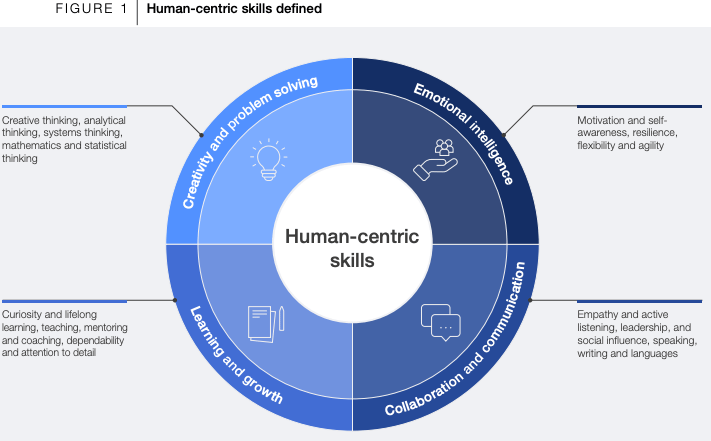
This new 39-page white paper provides guidance on the skills organizations should prioritize to ensure they have the talent needed to deliver on innovation, resilience, and growth priorities. As the first installment in a broader series, it focuses on human-centric skills—uniquely human capabilities such as collaboration, critical thinking, and emotional intelligence that enable effective interaction, problem-solving, and decision-making. While AI adoption continues to rise, these human skills remain essential for driving innovation and adaptability. The paper covers everything from the supply and demand of human-centric skills, with a breakdown by industry and geographic region, to tactics for developing, assessing, and credentialing these capabilities. One section beginning on page 30 includes seven case studies showing how organizations are embedding human-centric skills at scale. For example, Amazon Web Services (AWS) uses AI-powered simulations to help learners practice customer conversations and strengthen their problem-solving skills. PwC uses verified digital credentials to recognize behaviors like inclusive leadership. Udemy offers adaptive AI role plays that help learners rehearse difficult conversations and build confidence. Together, these examples show how organizations are scaling the development of human-centric skills in an AI-enabled world.

TALENT ACQUISITION
My cheat sheet with questions to help leaders decide whether to backfill vacant roles, reducing the costly cycle of overhiring.

This past week, Challenger, Gray & Christmas released its November job cuts report, which is a monthly analysis of corporate layoffs in the U.S. that helps track employment trends. While the November report offers several insights, one headline stands out: “U.S.-based employers announced 71,321 job cuts in November, up 24% from the 57,727 cuts announced in the same month last year. Through November, employers have announced 1,170,821 job cuts, an increase of 54% from the 761,358 announced in the first eleven months of last year.” As I’ve tracked thousands of layoffs through my layoff tracker, a common theme emerges: many organizations cite “overhiring” as a reason for workforce reductions, resulting in costly cycles of hiring, layoffs, and rehiring. Although better workforce planning and talent forecasting can help minimize the likelihood of overhiring, another important practice is to be intentional about whether a role truly needs to be backfilled when it becomes vacant. Rather than automatically replacing someone, leaders and talent partners can ask sharper questions, such as “Has the business context changed since the role was created?” and “How likely is this role to remain vital over the next two years?” to guide a more informed decision. To help facilitate these discussions, my one-page cheat sheet offers eight questions to spark deeper evaluation and better hiring choices. As AI reshapes how work gets done, questions like these can help reduce the cycle of overhiring and the job cuts that often follow.

AI IN THE WORKPLACE
A recently released 90-page report examines how GenAI has evolved in organizations over the past three years and where adoption and impact are headed next.
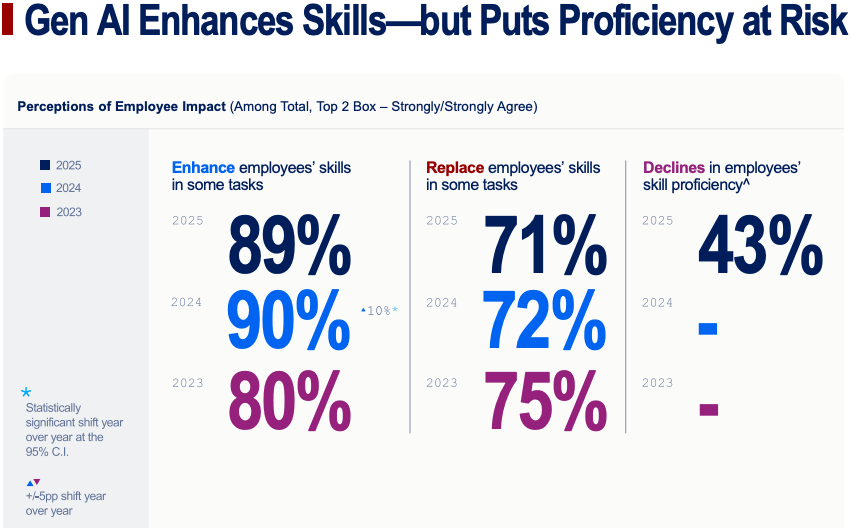
This recently published 90-page report provides a detailed view of the evolution of GenAI in organizations over the past three years (2023 through 2025). At a high level, the evolution can be described as: 2023 (Exploration): Initial curiosity, cautious use for simple tasks. 2024 (Experimentation): Increased pilots, focus on proving value. 2025 (Accountable Acceleration): Integration into core operations, ROI measurement, risk mitigation, and talent development. The study, now in its third year, is sponsored by Wharton Human-AI Research, part of the Wharton AI & Analytics Initiative at the Wharton School, University of Pennsylvania; GBK Collective performed the research and analysis. The cross-sectional study covers various topics, ranging from where the common use cases are, where returns are emerging, and which people and process-levers could convert mainstream use into sustainable ROI. Page 56 begins a section titled The Human Capital Lever: Aligning Talent, Training & Trust. One interesting chart on page 60 shows that while AI is enhancing employees’ skills in some tasks, there are concerns about skills atrophy (declines in employees’ skill proficiency). Given the breadth of this report, readers will need to dig into it to explore its many insights. As a bonus, you can check out a working paper by researchers at Harvard Business School and Stanford University titled, The GenAI Wall Effect: Examining the Limits to Horizontal Expertise Transfer Between Occupational Insiders and Outsiders. It shows that while GenAI helps bridge expertise gaps, it eventually reaches a point where it can no longer meaningfully narrow the gap between occupational insiders and outsiders. One implication is that domain knowledge and contextual understanding remain essential for interpreting GenAI-enabled output.
MOST POPULAR FROM LAST WEEK
TALENT MANAGEMENT
My new cheat sheet with sample questions leaders can use to accelerate timely talent decisions into immediate action.

Talent reviews and performance management are critical enablers of organizational performance. Yet a common pitfall is treating these practices as scheduled process events rather than prompts for timely, ongoing, and proactive actions. To help, I’ve created a one-page editable cheat sheet with seven targeted questions that enable leaders and teams to accelerate talent decisions at any moment.
JOB CUTS AND LAYOFF TRACKER
Check out my tracker of announcements from a segment of organizations that have conducted job cuts and layoffs since the start of 2023.

Partial view of my job cuts tracker on brianheger.com
A few job cuts announced this past week:
McKinsey & Co. The consulting firm cut about 200 global technology roles as it accelerates the use of AI to automate internal functions.
Omnicom Group (NYSE: OMC). The global marketing and communications company said it will cut more than 4,000 jobs and shut down several agency brands following its $13.5 billion acquisition of Interpublic Group.
UBS Group AG (NYSE: UBS). The Swiss multinational bank is reportedly planning to cut up to 10,000 additional jobs by 2027 as part of its ongoing integration of Credit Suisse, which UBS acquired in 2023.
CHIEF HR OFFICER MOVE OF THE WEEK
This past week, 12 new CHRO announcements were posted on CHROs on the Go, my subscription platform tracking movement in and out of the CHRO role.

This week’s CHRO move of the week is:
Corning Incorporated (NEW YORK) [NYSE: GLW]—one of the world's leading innovators in materials science—has announced the promotion of Michelle Gullo to the role of Chief HR Officer. Gullo served for approximately 14 years as Division VP of HR Corporate Staffs, Science, Technology, and Engineering at Corning Incorporated. Prior to joining Corning, Gullo built a robust foundation over nearly 15 years at IBM, where she held multiple HR leadership roles across the United States and global regions.

👉️ To access all detailed 12 CHRO announcements from this past week and over 4,500 archived announcements, join a monthly or yearly subscription to CHROs on the Go.
If you are already a subscriber to CHROs on the Go, log in here.
FROM ME ON LINKEDIN
Catch up on what you may have missed from me on LinkedIn:
THE BEST OF NOVEMBER 2025
SPONSORED BY

Did you miss the “Best of November ” issue of Talent Edge Weekly? If so, check out issue #325, which includes the most popular resources from the month.
You’re invited to attend i4cp's Next Practices Now Conference (March 30 – April 2, in-person or virtual) to connect with other senior HR leaders to unpack what makes future-ready organizations tick. Sign up by Dec. 12 to save $300, and use the code TALENTWEEKLY to save another $300—for a limited time.
Want to get your brand, product, or service in front of our active 55,000+ Talent Edge Weekly subscribers? Learn how to become a potential sponsor.
Talent Edge Weekly is written by Brian Heger, a human resources practitioner. You can connect with Brian on LinkedIn and brianheger.com
🗣️ WANT MORE?
Want access to all my curated resources?
👉️ Visit my website, brianheger.com
Are you an internal HR practitioner?
👉️ Apply for my private, paid community, Talent Edge Circle
Are you a provider of HR-related services?
👉️ Become a sponsor of Talent Edge Weekly
Want to know who’s moving in and out of the CHRO role?
👉️ Join my CHROS on the Go subscription