- Talent Edge Weekly
- Posts
- Talent Edge Weekly - Issue 325 - Best of November 2025
Talent Edge Weekly - Issue 325 - Best of November 2025
Here are the most popular articles and resources from the November issues of Talent Edge Weekly.

Brian Heger
November 30, 2025

SPONSORED BY

Welcome to this special Best of November issue of Talent Edge Weekly!
First, a shout-out to Zoe Winsey-Thomas, Head of Talent Management at bp, for referring new subscribers to Talent Edge Weekly. Thank you, Zoe, for your support of this newsletter!
🗞️ Not subscribed to Talent Edge Weekly? Subscribe now and immediately get 5 of my PDF cheat sheets!
PRESENTED BY The i4cp Next Practices Now Conference
Sign up for the top-rated HR conference by Dec. 12 to save $600
You’re invited to attend i4cp's Next Practices Now Conference (March 30 – April 2, in-person or virtual) to connect with other senior HR leaders to unpack what makes future-ready organizations tick.
Unlike most conferences, i4cp’s event:
Has no vendors. Only HR practitioners are allowed
Connects you with 500+ HR execs and decision makers
Focuses on strategic issues, from AI to culture
Offers a CHRO-led agenda, with leaders from John Deere, Zillow, DICK’S, Accenture & more
Sign up by Dec. 12 to save $300, and use the code TALENTWEEKLY to save another $300—for a limited time.
P.S. - Join i4cp on Jan 15 at 1 pm ET for a deep dive into their forthcoming 2026 Priorities & Predictions report, drawing from the collective expertise of CHROs and Sr. HR leaders to identify the forces that will shape the year ahead.
THIS MONTH’S CONTENT
The Best of November includes the most popular resources from the November issues of Talent Edge Weekly. They're organized into two sections:
🧰 Talent Practices: Linking HR results to business outcomes; fast-tracking talent decisions; breaking workforce planning out of its silo; unlocking trapped workforce capacity; talent sharing diagnostic; global mobility benchmarking report; making tough leadership decisions; 24 succession planning metrics; CEO succession planning; and hybrid work and more.
🤖 AI in the Workplace: AI adoption trends and the practices that separate leading organizations; how AI adoption trends are outpacing strategy and what organizations should consider; 9 questions about agentic AI; and a webinar on unlocking AI’s potential.
This issue has many bonus resources, including information about layoffs and Chief HR Officer hires and promotions during November.
Since this special issue contains a large amount of content, it may get cut off by some email providers. If you prefer, you can read it online.
🔥 For those in my private community for internal HR practitioners—Talent Edge Circle—I look forward to our 12/3, Wed. Hot Seat discussion, where you can get feedback from me and others on a critical work initiative you need support with, a challenge you’re facing, and other areas. See you then! 🔥
Let’s dive in. ⬇️

Brian Heger
THIS MONTH’S EDGE
I. 🧰 TALENT PRACTICES
Linking HR results to business outcomes; fast-tracking talent decisions; breaking workforce planning out of its silo; unlocking trapped workforce capacity; talent sharing diagnostic; global mobility benchmarking report; making tough leadership decisions; 24 succession planning metrics; CEO succession planning; and hybrid work and more.

HR’S BUSINESS IMPACT
An excerpt slide from my private Talent Edge Circle community that shows an example of how year-end HR results contribute to various business outcomes.

As many HR leaders and their teams begin summarizing the outcomes they delivered this year, it is impactful to organize accomplishments by the business results they enabled rather than simply listing activities completed. One approach is to start with the business outcome of greatest importance and use a few reflection questions to surface the accomplishments that best demonstrate impact. For example, if Revenue Growth is a priority (e.g., increasing income through higher sales, customer acquisition, or market expansion), you might ask: How did our talent practices strengthen the capabilities of revenue-impacting teams? Where did workforce decisions (hiring, development, mobility) support growth priorities? How did we ensure the right people were in the right roles to enable expansion? These are simply starting points that you can adjust to your context. And while Revenue Growth is one example, the same approach can be applied to outcomes such as Profitability and Margin Improvement, Operational Efficiency, Customer Experience and Satisfaction, and Strategic Agility and Organizational Adaptability, among others. To make this easier to put into practice, I’m sharing an excerpt slide from my private Talent Edge Circle community—a one-pager you can copy, adapt, and use with your team, which shows a full example linked to all five business outcomes.

TALENT MANAGEMENT
My new cheat sheet with sample questions leaders can use to accelerate timely talent decisions into immediate action.
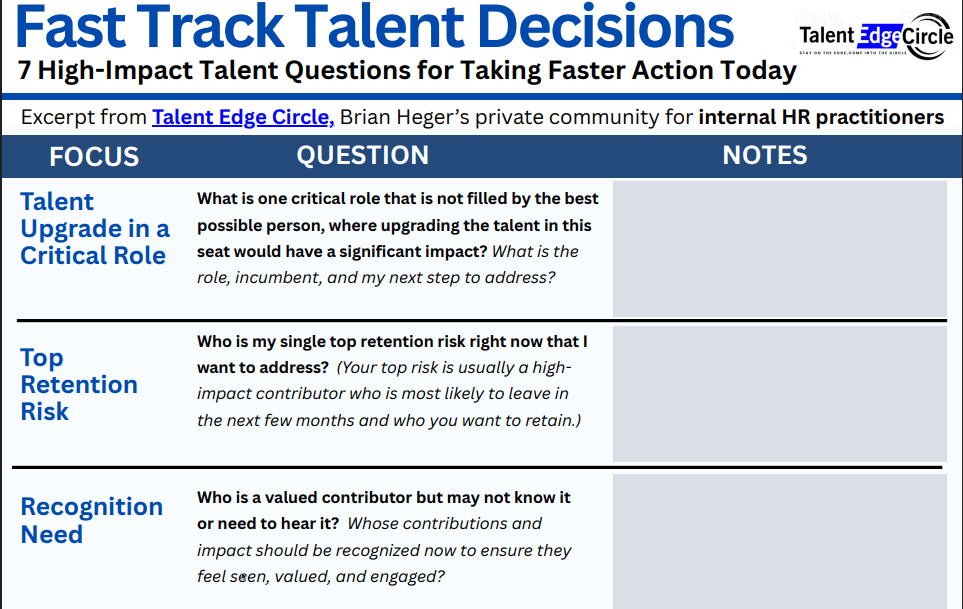
Talent reviews and performance management are critical enablers of organizational performance. Yet a common pitfall is treating these practices as scheduled process events rather than prompts for timely, ongoing, and proactive actions. To help, I’ve created a one-page editable cheat sheet with seven targeted questions that enable leaders and teams to accelerate talent decisions at any moment. For example, Talent Upgrade in a Critical Role: What is one critical role where upgrading the talent in this position would have a significant and positive business impact? What is the role, who is the incumbent, and what is my next step? Hidden Talent: Who is a strong performer whose contributions or potential go largely unrecognized, and what step will I take to increase their visibility? Recognition Need: Who is a valued contributor who may not realize their impact, and whose contributions should be acknowledged now to ensure they feel seen, valued, and engaged? The final column includes editable text boxes that allow leaders to track their decisions and actions in real time, serving as a simplified action plan. Imagine the impact if managers and leaders answered and acted on even one of these questions, let alone several. Use this cheat sheet to make faster, sharper talent decisions. As a bonus, here is one of my cheat sheets for talent reviews, which covers key questions to address, talent segments to retain, and sample high-potential metrics.

WORKFORCE PLANNING
A new article that outlines how organizations can modernize workforce planning by integrating functions, democratizing data, and enabling real-time decision-making across teams.

Over the years, I’ve written about how one challenge in implementing strategic workforce planning (SWP) is that it is often done in silos, without meaningful integration across business strategy, finance, operations, technology, and HR. I’ve shared this perspective in 1) book chapters, 2) articles, and 3) one-page cheat sheets. And while there are many barriers to SWP, addressing the foundational one of moving the work out of silos is one of the most impactful steps organizations can take to build momentum and improve effectiveness. A new Deloitte article highlights this point by demonstrating how leading companies are transitioning SWP from a static, siloed exercise to a dynamic, cross-functional capability that integrates strategy, operations, HR, finance, technology, and AI transformation. Deloitte notes that this requires both horizontal and vertical expansion. Horizontal expansion brings more functions into the process, as shown by Network Rail, Britain’s rail infrastructure owner and operator, which cut hiring and training time for key signaler roles by 50 percent through a cross-disciplinary team, and by a global biotech firm that saved $94M (USD) by integrating insights across stakeholder groups. Vertical expansion democratizes planning by giving managers and employees access to data, with organizations like Roche (open analytics access), IBM (visibility into in-demand roles and skills), and Google (dashboards and “what if” scenarios), enabling real-time decisions. Other ideas for how organizations can create SWP synergies across teams to make the practice more impactful are discussed.

WORKFORCE PLANNING
A new article highlights how organizations can unlock “trapped workforce capacity” through tactics such as surfacing hidden skills, reducing low-value work, and leveraging AI and internal mobility.

One of the topics I wrote about in my book chapter on strategic workforce planning is the challenge of “trapped workforce capacity,” or the talent, skills, and resources that exist within an organization but aren’t fully utilized or reflected in workforce plans. When this capacity is overlooked, it can lead to over-hiring, misaligned resourcing, and missed opportunities to use existing talent more effectively. I’ve also shared several of my one-page cheat sheets, including this one, illustrating how improved ways of working can unlock capacity within the workforce. A new Deloitte article reinforces this point by highlighting the capacity and capability that sit “below the surface” of traditional workforce planning. It outlines several strategies to uncover it, including activating talent marketplaces, leveraging adjacent skills to redeploy workers into in-demand roles, and factoring in digital capacity from AI agents and automation. The article also goes deeper into these tactics with company examples showing how organizations are already putting them into practice. My suggestion for getting started is this: brainstorm where trapped workforce capacity might exist in your organization, narrow the list to the areas with the greatest impact, refine it to what is easiest to tackle, and pick one to address in the next 60 days (ensuring you gain stakeholder alignment and support). Feel free to use my cheat sheet to help identify opportunities.

INTERNAL MOBILITY
My one-page cheat sheet to help managers identify and address behaviors that may unintentionally limit internal mobility within the organization.
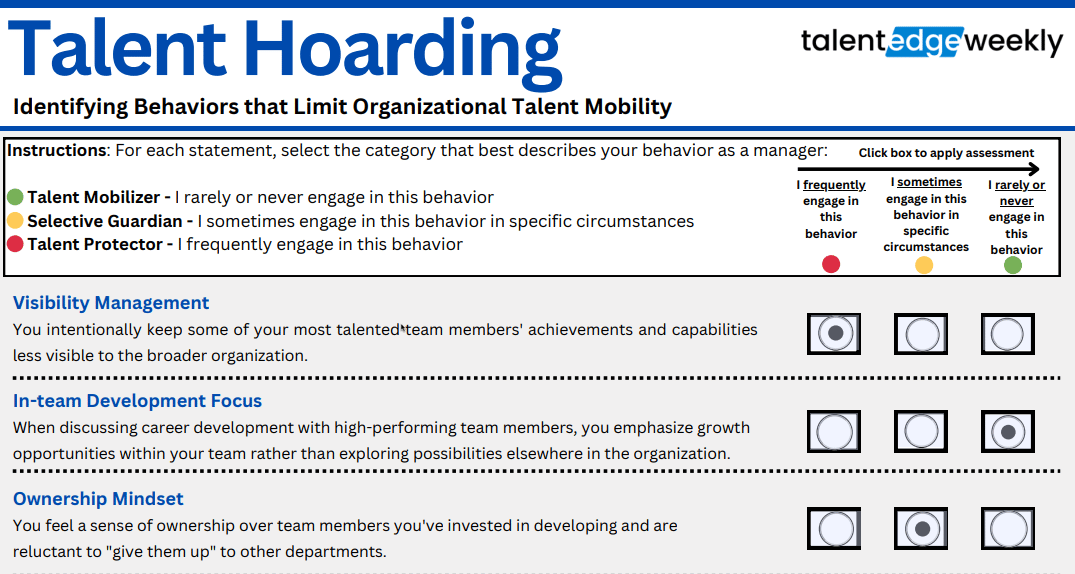
I recently shared my cheat sheet to help organizations evaluate whether their internal mobility policies and guidelines support or hinder talent movement. While some policies are necessary, others may create unintended barriers by over-regulating the process and timing of internal moves. Beyond policies and guidelines, another barrier to internal mobility is “talent hoarding,” in which managers, knowingly or unknowingly, discourage high performers from pursuing internal opportunities. Managers often hoard talent for understandable reasons: they rely on top performers to meet team goals, they’ve invested time in developing these employees, they fear productivity drops if key talent leaves, and they are often evaluated on team performance rather than talent development. However, research shows that talent hoarding can have unintended consequences for managers, while sharing talent can yield benefits. Since many managers may not realize they are exhibiting these behaviors, self-awareness is a critical first step. To support this, I’ve included my one-page cheat sheet with 10 reflection statements to help managers assess their talent-sharing mindset. As many organizations enter performance evaluations for the year, when career development, future roles, and potential moves are often part of the discussion, this cheat sheet can serve as a timely reference to help managers assess whether they are enabling or hindering internal mobility.
There is much more content in this issue, but you must be subscribed (or logged in if you are a subscriber) to access the rest. It is FREE to sign up, and a new issue comes out every Sunday, 6 PM EST! ⬇️