- Talent Edge Weekly
- Posts
- Talent Edge Weekly - Issue #338
Talent Edge Weekly - Issue #338
9 talent decisions that can be made at any time, AI's impact on the labor market, organizational design of support functions, succession planning diagnostic, and caregivers as an untapped talent segment.

Brian Heger
March 15, 2026

SPONSORED BY

Welcome to this issue of Talent Edge Weekly!
First, a shout-out to Luis De Rojas Dierssen, Global Employment Counsel & Full-Stack HR at Typeform, for referring new subscribers to Talent Edge Weekly. Thank you, Luis, for your support of this newsletter!
PRESENTED BY TechWolf
Boards are no longer asking if AI matters. They are asking which business units will feel the impact first and what it means for next quarter’s financials. Here is the operating reality:
Most enterprises are making billion-dollar AI infrastructure investments with limited insight into the human side of the equation.
They can tell you how many GPU clusters they are provisioning, but they cannot tell you which roles are most exposed to disruption or where the biggest productivity gains will come from.
At TechWolf, we believe the AI revolution is a people transformation, not just a technology deployment.
Read our latest Vision Paper to learn about three moves high-performing HR functions are making to lead this revolution.
Have a product or service that could provide value to our active 57,000+ Talent Edge Weekly subscribers? Become a potential sponsor.
THIS WEEK'S CONTENT
Below are links and descriptions of the topics covered in this issue. If you're interested in my deep dive, you can read the full newsletter.
9 Examples of Talent Decisions Leaders Can Make Proactively | Brian Heger | My cheat sheet with nine examples of proactive talent decisions to help leaders build talent management as an ongoing capability.
Research on AI and the Labor Market Is Still in the First Inning | The Brookings Institution | A new analysis argues that many questions about AI’s workforce implications remain unresolved, helping distinguish signals from evidence.
Have Organizational Functions Outlived Their Function? | Deloitte Insights | Examines whether traditional corporate function structures are still fit for purpose and offers a framework for evaluating whether design decisions should be organized around strategic outcomes.
Succession Planning Diagnostic | Brian Heger | My one-page diagnostic helps practitioners assess 10 sample areas to identify opportunities to improve their succession planning practices.
Why Businesses Should Value Caregivers Now | MIT Sloan Management Review | Explores the case for viewing caregivers who have taken time away from work to care for others as a valuable source of talent.
Also, check out my job cuts tracker & Chief HR Officer move of the week, which is an excerpt from my CHROs on the Go platform (subscription-based), where I track hires, promotions, and exits in the Chief HR Officer role.
TALENT EDGE CIRCLE
👉️ If you’re an internal HR practitioner who wants to go deeper with me and other internal HR practitioners on talent topics tied to your most critical priorities, learn about my private community, Talent Edge Circle.
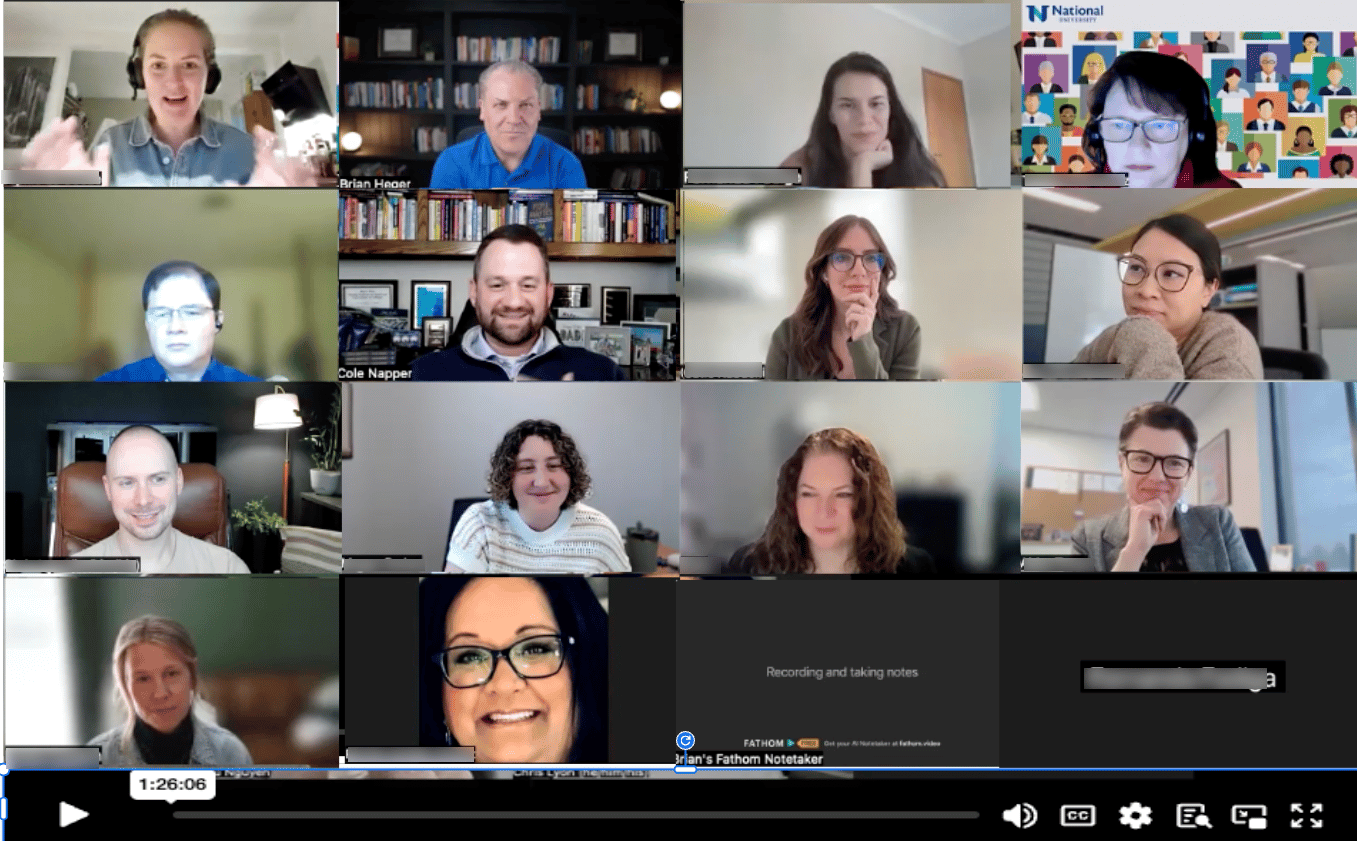
Screenshot of recent discussion on data-driven HR w/ Cole Napper
A special thanks to Cole Napper, Ph.D., for joining me and the Talent Edge Circle, last week for a strategic discussion on data-driven HR decision-making! If you’re looking to drive more evidence-based HR and talent decisions that deliver real business value—and to do so in a practical and actionable way—I recommend checking out Cole’s Data Driven HR Academy. |

⬇️ Now let’s dive in.

THIS WEEK'S EDGE

TALENT MANAGEMENT
My cheat sheet with nine examples of proactive talent decisions to help leaders build talent management as an ongoing capability.

Organizational talent processes and practices, such as talent reviews and performance management, are critical enablers of organizational performance. Yet a common pitfall is treating them as areas of focus only at a few select times of the year rather than as opportunities for ongoing, proactive talent decisions. When we rely too heavily on formal processes to make important talent decisions, two things happen: 1) we fail to build the organizational muscle to make better, faster talent decisions in the daily flow of work, and 2) we miss or delay opportunities to drive organizational performance through more intentional talent management. My cheat sheet includes nine examples that can help leaders and managers accelerate talent decisions at any moment. Talent Upgrade in a Critical Role, for example, asks whether a critical role is filled by the person best suited to drive business impact and what the next step is if a change is needed. Formal talent processes serve an important purpose, but leaders should also use the daily flow of work to create more opportunities to drive organizational performance through talent management.

AI’S IMPACT
A new analysis argues that many questions about AI’s workforce implications remain unresolved, helping distinguish signals from evidence.

In this new Brookings Hamilton Project analysis report, economist Jed Kolko argues that the biggest questions about AI and the labor market remain unanswered for three reasons: 1) early findings on labor demand are inconclusive in part because there are now numerous AI exposure and usage measures being used in AI research, and they do not fully agree on which occupations are most affected; 2) current findings are weak signals about the future given how recently LLMs entered widespread use; and 3) labor demand is only one slice of a much bigger picture that also includes productivity, labor supply, and transition dynamics, meaning how smooth or disruptive the workforce transition may be along the way. One caution for practitioners is Kolko's warning about "streetlamp bias," or the tendency to focus on what is easiest to measure rather than where the most important effects may actually be emerging. For HR leaders, the implication is to build workforce strategies that are grounded in the available evidence, flexible enough to adapt as the research matures, and be clear with stakeholders about what is known versus what remains uncertain. You can get more recent reports on the impact of AI on jobs, work, and the labor market here on my website.

ORGANIZATION DESIGN
Examines whether traditional corporate function structures are still fit for purpose and offers a framework for evaluating whether design decisions should be organized around strategic outcomes.
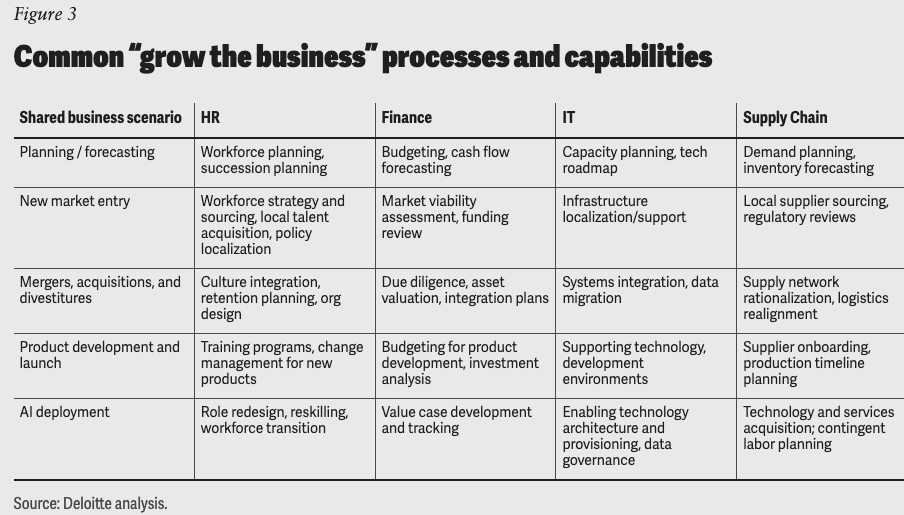
As organizations rethink how work gets organized in response to AI, faster business cycles, and growing pressure for cross-functional execution, this Deloitte Insights article raises an important question: are traditional corporate functions such as HR, finance, IT, legal, and procurement still fit for purpose? Its core argument is that these functions were designed for specialization and efficiency, but many are no longer set up to support the speed, agility, and coordination that today's business priorities require, and Deloitte's survey of 9,000+ leaders found only 7% are making great progress here. One framework in the article separates work that helps "run the business" from work that helps "grow the business." Run-the-business work covers repeatable, transaction-heavy activities suited for standardization, automation, and shared delivery models. Grow-the-business work (as shown in the post image) centers on strategic scenarios such as AI deployment, M&A, and market expansion, where success depends on aligning expertise around a shared outcome and is better suited for cross-functional teams organized around those outcomes. The distinction matters for design: not all functional work should be reorganized the same way, and clarity on which category a given activity falls into can help leaders make more deliberate decisions about structure, accountability, and where to invest in capability.

SUCCESSION PLANNING
My one-page diagnostic helps practitioners assess 10 sample areas to identify opportunities to improve their succession planning practices.

Succession planning (SP) continues to be a top priority for many organizations, and it is one of the topics Talent Edge Weekly readers most often ask me to cover. But in many cases, organizations do not struggle because they lack interest in SP. They struggle because they have not clearly identified where their SP practices need to improve to drive greater impact. Against that backdrop, I’m sharing my one-page diagnostic to help organizations identify opportunities to strengthen their SP. It covers 10 sample areas and, while not exhaustive, offers a practical starting point for assessing where the process may need more attention. Practitioners can review each statement and select one of three rating categories, including Needs Attention for areas with significant opportunity for improvement. For example, one area is Business Strategy Alignment: “Our succession planning process is aligned with the organization’s long-term strategic goals and regularly reviewed to adapt to changing business needs.” Once completed, the diagnostic provides a visual snapshot of results through color-coded boxes based on the selected ratings, which can help identify priorities for follow-up action. These 10 areas are intended as starting points, so adapt and modify them as needed for your organization.
There is more content in this issue, but you must be subscribed (or logged in if you are a subscriber) to access the rest. It is FREE to sign up, and a new issue comes out every Sunday, 6 PM EST! ⬇️