- Talent Edge Weekly
- Posts
- Talent Edge Weekly - Issue #337
Talent Edge Weekly - Issue #337
Deloitte's 2026 Human Capital Trends report, AI's impact on jobs, preventing goal creep in performance management, first-time Chief HR Officers, and skills-based talent practices.

Brian Heger
March 08, 2026

SPONSORED BY

Welcome to this issue of Talent Edge Weekly!
First, a shout-out to Ana Carolina Costa, Senior Manager, Business Human Resources at Abbott, for referring new subscribers to Talent Edge Weekly. Thank you, Ana, for your support of this newsletter!
PRESENTED BY 365Talents
A Docebo Company
2026 marks a turning point for skills, job readiness, and workforce strategy. The question isn’t whether skills will disrupt how organizations plan their workforce, but whether leaders are ready.
Roles are evolving faster than job frameworks, skills are expiring sooner than expected, and static HR models are struggling to keep up.
The 2026 Skills Impact Report cuts through the noise with a clear roadmap for tackling what’s ahead and fully harnessing the power of skills.
Have a product or service that could provide value to our active 57,000+ Talent Edge Weekly subscribers? Become a potential sponsor.
THIS WEEK'S CONTENT
Below are links and descriptions of the topics covered in this issue. If you're interested in my deep dive, you can read the full newsletter.
2026 Deloitte Global Human Capital Trends | Deloitte Insights | A new 79-page report explores issues shaping the future of work, workforce, and workplace. I expand on the volume of change workers are experiencing.
Labor Market Impacts of AI: A New Measure and Early Evidence | Anthropic | A new 17-page report compares AI’s theoretical capability potential with real-world usage data, showing where adoption still lags.
Performance Management: 6 Questions for Preventing Goal Creep Year Round | Brian Heger | My one-page cheat sheet helps organizations address goal creep by evaluating newly added goals through explicit discussions about capacity, priorities, and trade-offs.
First-Time Chief People Officer Guide: 2026 Update | Heidrick & Struggles | Highlights eight enablers of success for first-time Chief HR Officers. I build on one: being a commercial business leader first and an HR leader second.
Anchoring Degrees, Accelerating Skills: Policies Towards A Stackable, SkillsFirst Ecosystem | World Governments Summit 2026 with PwC | A 40-page report on moving beyond degree-only talent credentials toward skills-based hiring. I share my cheat sheet to help evaluate those decisions.
Also, check out my job cuts tracker & Chief HR Officer move of the week, which is an excerpt from my CHROs on the Go platform (subscription-based), where I track hires, promotions, and exits in the Chief HR Officer role.
TALENT EDGE CIRCLE
👉️ If you’re an internal HR practitioner that wants to go deeper with me and other internal HR practitioners on talent topics related to your critical priorities, learn about my private community, Talent Edge Circle.

Screenshot of recent discussion on performance management w/ Marc Effron
⬇️ Now let’s dive in.

THIS WEEK'S EDGE

FUTURE OF WORK
A new 79-page report explores issues shaping the future of work, workforce, and workplace. I expand on the volume of change workers are experiencing.

This past week, Deloitte released its 2026 Global Human Capital Trends report, a 79-page resource that explores the forces reshaping work, the workforce, and the workplace. One chapter beginning on page 55 puts numbers behind something many HR practitioners already feel: workers are being asked to absorb a relentless volume of change, but most organizations are still not equipped to help employees adapt at that pace. Deloitte found that one-third of workers experienced 15 major changes in the past year alone, with that level of change taking a toll on well-being and workload. Yet only 27% of respondents believe their organizations manage change effectively. Deloitte recommends moving beyond traditional change management and formal training by building adaptation into daily work. As I’ve pointed out before, many changes are introduced simultaneously not because leaders intend to overload the organization, but because they often lack visibility into the cumulative change load and sufficient coordination across initiatives. That is why I am resharing my cheat sheet to help leaders review current and proposed changes, their timing, and their impact across groups. It serves as a starting point for better aligning the pace of change with employees’ capacity to adapt, helping improve the success of change efforts while preserving employee well-being.

AI’S IMPACT ON WORK
A new 17-page report compares AI’s theoretical capability potential with real-world usage data, showing where adoption still lags.

HR practitioners continue to tap into data and insights to help their organizations understand and prepare for AI’s impact on jobs and work. With this in mind, I recently shared two useful resources: 1) The Brookings Institution analysis pairing AI exposure with an “adaptive capacity” index to show where worker resilience is high or vulnerability is concentrated; and 2) HBS Working Knowledge research on how AI is shifting job demand, including an interactive tool showing which occupations are more likely to be enhanced versus eliminated. This past week, a new 17-page report from Anthropic was also widely shared. Using a new metric, “observed exposure,” it compares theoretical AI capability with real-world usage data and finds that, in most sectors, actual adoption remains only a fraction of what AI is theoretically capable of doing. One implication I draw for workforce planning and related areas is that organizations should not treat AI’s potential capability as the same thing as immediate workforce impact. Instead, leaders should distinguish between roles/jobs/work with high theoretical but low actual adoption, high actual adoption, and low exposure. Those distinctions matter because they lead to different conclusions, prioritization, and actions. Relying only on theoretical exposure could prematurely lead to workforce reductions or restructuring. A better use of this data is to identify where role redesign, reskilling, and shifts in productivity expectations are most likely to emerge first so efforts can be prioritized more thoughtfully.

PERFORMANCE MANAGEMENT
My one-page cheat sheet helps organizations address goal creep by evaluating newly added goals through explicit discussions about capacity, priorities, and trade-offs.
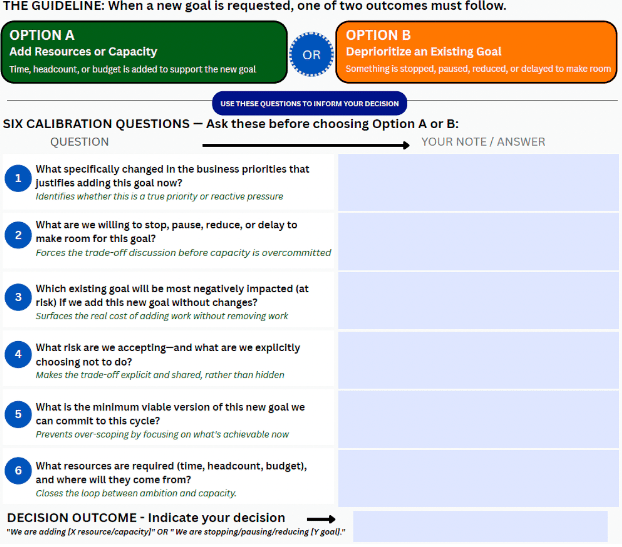
Performance goals and objectives for the year are already well underway. Even with goals set and resourced at the start of the cycle, it often doesn’t take long before new goals are added to an existing plan. If these additions aren’t managed intentionally, they can introduce competing priorities that outpace capacity, putting both original and new objectives at risk. This is often referred to as goal creep, when goals expand without recalibrating priorities and resources. To help teams address this, here’s my new one-page cheat sheet to evaluate any new goal and clarify what will change to make room for it. It starts with a simple premise: when a new goal is added, one of two things should happen. Either resources are added to support it, or an existing goal is deprioritized to make room. The tool also includes six questions to guide the discussion, such as: What specifically changed in the business priorities that justifies adding this goal now? What are we willing to deprioritize to make room? What is the minimum viable version of this new goal we can commit to this cycle? This tool isn’t meant to be rigid. It’s a strategic exercise to stay intentional about what work is taken on, protect critical business priorities, and strengthen company performance, which is a core aim of performance management.
There is more content in this issue, but you must be subscribed (or logged in if you are a subscriber) to access the rest. It is FREE to sign up, and a new issue comes out every Sunday, 6 PM EST! ⬇️