- Talent Edge Weekly
- Posts
- Talent Edge Weekly - Issue #333
Talent Edge Weekly - Issue #333
Nine trends shaping work in 2026, removing barriers to internal mobility, the Chief HR Officer's role in unlocking the potential of AI, supporting employees through transitions, and building the business case for expanding or building HR teams.

Brian Heger
February 08, 2026

SPONSORED BY

Welcome to this issue of Talent Edge Weekly!
First, a shout-out to Bill Agostini, Sr. Director, Talent Management & OD at Veolia North America, for referring new subscribers to Talent Edge Weekly. Thank you, Bill, for your support of this newsletter!
PRESENTED BY 365Talents
A Docebo Company
2026 marks a turning point for skills, job readiness, and workforce strategy. The question isn’t whether skills will disrupt how organizations plan their workforce, but whether leaders are ready.
Roles are evolving faster than job frameworks, skills are expiring sooner than expected, and static HR models are struggling to keep up.
The 2026 Skills Impact Report cuts through the noise with a clear roadmap for tackling what’s ahead and fully harnessing the power of skills.
Want to get your brand, product, or service in front of our active 55,000+ Talent Edge Weekly subscribers? Learn how to become a potential sponsor.
THIS WEEK'S CONTENT
Below are links and descriptions of the topics covered in this issue. If you're interested in my deep dive, you can read the full newsletter.
9 Trends Shaping Work in 2026 and Beyond | Harvard Business Review | A new article by the HR team at Gartner outlines nine AI-era workforce risks for 2026. I expand on one related to performance and ways of working.
Spotting Policy and Guideline Friction in Internal Mobility | Brian Heger | My cheat sheet highlights nine policies and guidelines that can slow internal moves, paired with questions to pressure test whether each is warranted.
The Reinvention of the CHRO in an AI-Driven Enterprise | BCG | A new article supplemented by a 35-page slide deck that frames the CHRO as a key driver of AI-enabled work redesign across the organization, starting with HR.
A One-Page Cheat Sheet for Building the Business Case for New HR Teams | Brian Heger | My one-pager to help HR leaders think through nine areas for creating a business case for building or expanding HR teams.
Navigating the AI-Enabled Workforce Shift: From Managing Exits to Orchestrating Ecosystems | Deloitte Insights | A new article that focuses on building “ramps” to support worker transitions and keep skilled alumni close.
Also, check out my job cuts tracker & Chief HR Officer move of the week.
TALENT EDGE CIRCLE - My private community
A special thanks to Ravin Jesuthasan, co-author of The Skills-Powered Organization and Sr. Partner and Global Leader for Transformation Services at Mercer, for joining me and my private community for internal HR practitioners, Talent Edge Circle, last week for a strategic discussion on the future of work and skills-based talent practices! If you’re looking for consulting support from a top thought leader in our space, I recommend reaching out to Ravin on LinkedIn to learn how he can help. |

👉️ Talent Edge Circle is my private community for internal HR practitioners, bringing together practitioners in similar roles and at similar levels who share common priorities and challenges. This keeps the focus on the work that matters most. Learn more and apply today.
⬇️ Now let’s dive in.

THIS WEEK'S EDGE

AI AND WORK TRENDS
A new article by the HR team at Gartner outlines nine AI-era workforce risks for 2026. I expand on one related to performance and ways of working.

Much of the conversation about AI in the workplace has focused on investment and upside potential. Yet organizations must also address the second-order risks of AI adoption, meaning the unintended consequences that emerge in execution, culture, and the employee experience as AI use scales. A new HBR article from Gartner’s HR practice highlights nine AI-era trends that reveal where AI can create risk in the workforce, including premature AI-driven layoffs that lead to costly rehiring, low-quality output that fuels “workslop” as employees are pushed to deliver more with less time for quality checks, and rising distrust in hiring as automation expands. One area that stood out to me is the warning that AI can create operating conditions that drive unrealistic performance pressures, quietly eroding results. While this is framed as an AI issue, the broader lesson applies to any ways of working that enable—or hinder—an organization’s ability to achieve its goals. With that in mind, I’m resharing my editable one-page cheat sheet that helps leaders and teams identify which current work practices may hinder goal achievement. It’s anchored in one question: “If we fast-forward to year-end and fell short of this objective, which ways of working would we say got in our own way?” From there, teams can pinpoint two to three actions to turn risk into a performance advantage.

INTERNAL MOBILITY
My cheat sheet highlights nine policies and guidelines that can slow internal moves, paired with questions to pressure test whether each is warranted.

Internal mobility remains a top priority for many organizations. According to LinkedIn’s Workforce Learning Report 2025, more than 48 percent of organizations are making internal mobility a higher priority this year. Yet, as I shared in one of my cheat sheets, several factors can unintentionally limit internal mobility. These range from managers who hesitate to share top talent across the organization to the lack of enabling technologies, such as internal talent marketplaces, that make movement easier. Another common barrier involves the policies and practices that govern when employees can apply for, interview for, or move into internal roles or opportunities. To help you evaluate these areas—formal or informal—I created a one-pager with nine dimensions to consider. The cheat sheet includes brief questions to identify whether each practice exists in your organization and whether it is warranted or creating unnecessary friction that slows internal talent movement. For example, one area is level requirements for upward moves, where employees may only apply for roles one level above their current position when pursuing a promotion. Questions include: Why is the limit in place? When should exceptions apply for high-potential talent or scarce skills? Does the rule slow development, succession, or filling critical roles? Use this as a discussion tool to decide what to keep, refine, or eliminate.

AI AND CHIEF HR OFFICER
A new article supplemented by a 35-page slide deck that frames the CHRO as a key driver of AI-enabled work redesign across the organization, starting with HR.
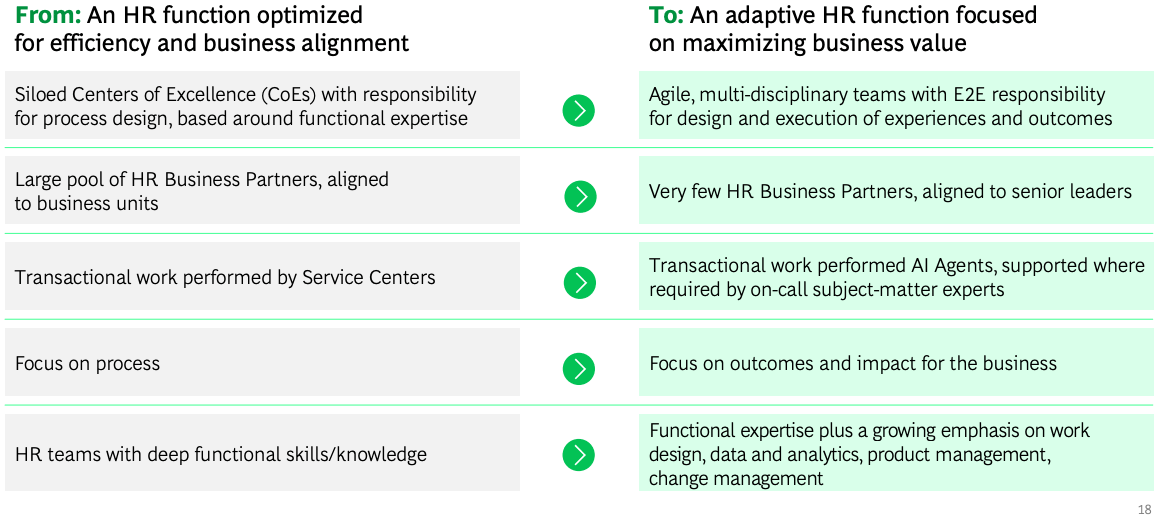
This new article, supported by a 35-page slide deck, positions the Chief HR Officer (CHRO) as a central driver of AI-enabled work redesign across the enterprise, beginning with the HR function. While these resources offer many insights, one point to reinforce is the 10/20/70 rule (10% algorithms, 20% technology and data infrastructure, 70% meaningful transformation of people, organization, and processes). The takeaway is that outcomes are mainly driven by how work is designed, governed, and executed. For example, here’s what that might look like in strategic workforce planning: the “10” involves using AI to accelerate scenario modeling, synthesize internal and external signals, and draft role and skill implications; the “20” focuses on dependable job and skills data, sound demand assumptions, integration with finance planning, and clear data access and documentation; and the “70” is the real unlock, aligning leaders on decision rights and cadence, defining triggers that prompt updates, building capability to interpret scenarios and make trade-offs, and translating insights into actions such as build, buy, borrow, automate, or redesign work, with clear ownership and outcome measures. The article also identifies five CHRO priorities for the next 12 months, including refreshing a skills-based strategic workforce plan for each function to assess AI’s impact on roles, skills, and activities, and to redesign 2030 labor models. Be sure to review the slide deck, which includes useful illustrations you can adapt for your own purposes.

HR EFFECTIVENESS
My one-pager to help HR leaders think through nine areas for creating a business case for building or expanding HR teams.

Many Talent Edge Weekly readers have shared with me that they’re creating new HR functions, expanding their teams, or building new ones. A key part of these efforts is developing a compelling business case. While business cases can vary in complexity, I’m sharing my one-page cheat sheet with guiding questions to help HR leaders and their teams think through the core components of their case. Whether you’re proposing an expanded talent management team or building the function from scratch, this nine-section resource covers everything from defining the business rationale to articulating ROI and mapping implementation timelines. It also includes a prompt, “What happens if we don’t act?,” to ensure your business case reflects the risks of not moving forward with the approval, helping decision-makers make informed choices. The cheat sheet helps turn what can feel like an overwhelming process into a clear, actionable plan. Feel free to use it if you believe it can accelerate your efforts.

TALENT MANAGEMENT
A new article that focuses on building “ramps” to support worker transitions and keep skilled alumni close.

This past week, Challenger, Gray & Christmas published its January 2026 layoff report, in which it noted that US.-based employers announced 108,435 job cuts in January, an increase of 118% from the 49,795 cuts announced in the same month last year. That context is why I found this new Deloitte Insights article timely. It suggests an opportunity for replacing “cliff” layoffs (abrupt exits that sever ties with an organization) with “talent ramps,” which are structured pathways that help people move into new internal roles or transition into the broader ecosystem while keeping skilled alumni connected for future opportunities, such as project roles, advising, contracting, or partnering. Examples include BMW’s Senior Experts Program, which brings retired engineers back in part-time, project-based roles to solve technical problems and mentor emerging talent, and Goldman Sachs’ alumni network of 115,000+ former employees, which helps keep relationships active (e.g., job marketplace access and events) and makes it easier to reconnect when needs emerge. To turn this into action, two questions: 1) Which roles are most likely to change in the next 6–18 months, and what are the 2–3 adjacent roles or projects people could ramp into? 2) What is our simplest mechanism to re-engage alumni for surge capacity or niche expertise that will fill our talent needs? As a bonus, I’m resharing my post “Rehiring Former Employees as a Talent Strategy,” which includes a cheat sheet to help identify which former employees you may want to re-engage for different needs.
There is more content in this issue, but you must be subscribed (or logged in if you are a subscriber) to access the rest. It is FREE to sign up, and a new issue comes out every Sunday, 6 PM EST! ⬇️