- Talent Edge Weekly
- Pages
- Talent Edge Weekly - Best of April 2026

SPONSORED BY

Welcome to this special Best of April issue of Talent Edge Weekly!
First, a shout-out to Erin Hanley Bostick, Head of Talent Management at Par Pacific Holdings, Inc., for referring new subscribers to Talent Edge Weekly. Thank you, Erin, for your support of this newsletter!
PRESENTED BY 365Talents
A Docebo Company
The Strategic Buyer Guide to Skills Intelligence
Every HR tech stack promises skills. But not every platform delivers actual intelligence — the kind that maps capabilities in real time, surfaces hidden potential, and connects workforce decisions to business priorities.
The Strategic Buyer Guide to Skills Intelligence helps you cut through the noise: 9 core capabilities to evaluate, high-impact use cases, and ready-to-use templates so you can compare platforms with confidence.
P.S. - Want to see 365Talents’ AI-powered skills intelligence platform in action? Book a demo
THIS MONTH’S CONTENT
This special Best of April issue includes the 16 most popular resources from the April issues of Talent Edge Weekly. They span two main areas:
Talent Practices. Focuses on specific talent practices including many of my cheat sheets, covering performance management, determining whether to backfill vacant roles, evaluating AI-based tools in hiring, advancing talent initiatives, skills-based practices, critical roles, succession planning, internal mobility, and engagement and retention.
AI in the Workplace. Covers how AI is transforming organizations and reshaping jobs, examining what separates successful enterprise AI deployments from failures, AI's impact on early-career roles, how AI is influencing employee engagement and the global workplace, and how organizations should approach work redesign in an AI era.
There are bonus resources, such as information about company layoffs and movement in and out of the Chief HR Officer role.
My Private Community
If you’re an internal HR practitioner who wants to go deeper with me and other internal HR practitioners on talent topics tied to your most critical priorities, learn about my private community, Talent Edge Circle.
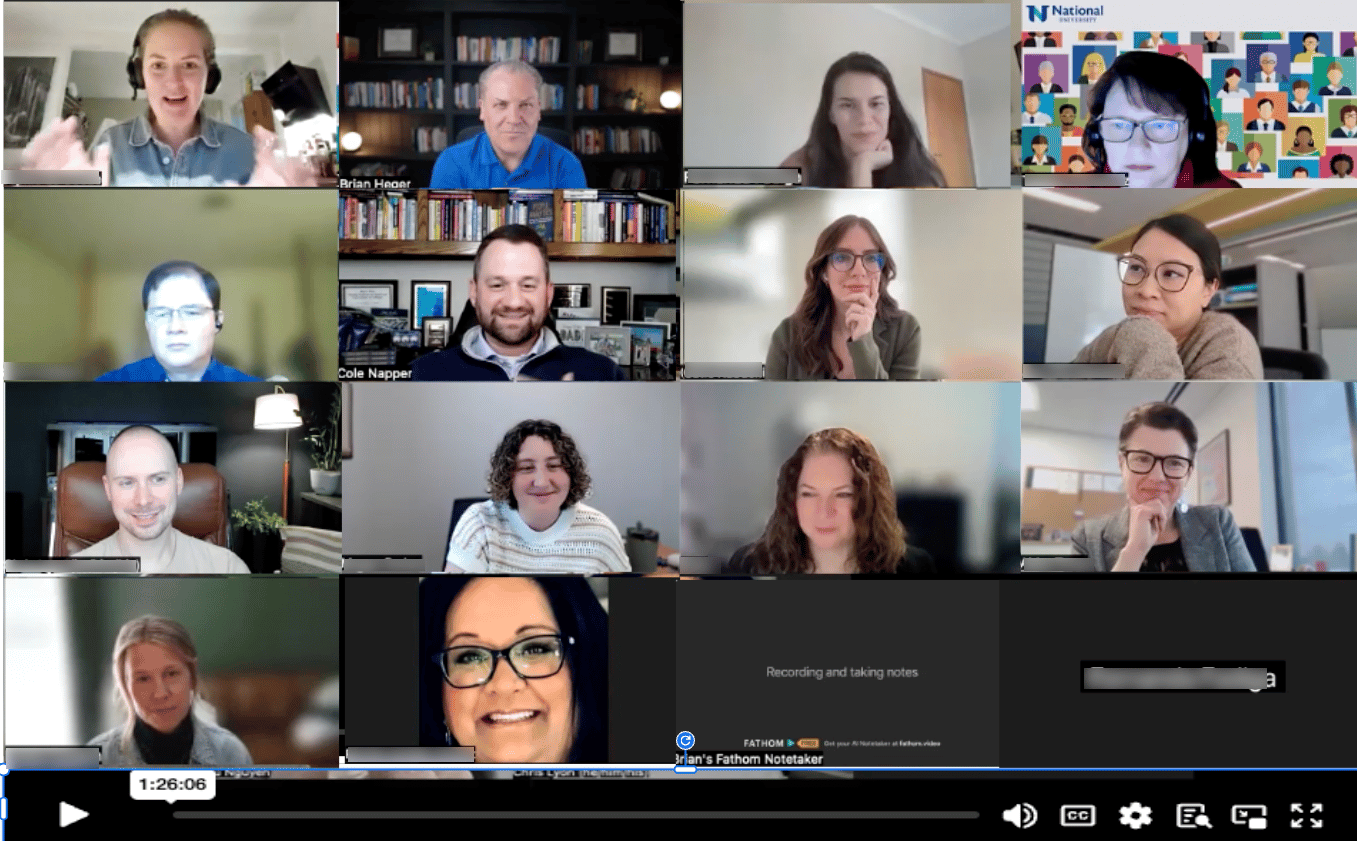
🗓️ May 6, Anna Tavis, thought leader and Department Chair, Human Capital Management at New York University, will join Talent Edge Circle for a discussion on how organizations are scaling digital and AI-enabled coaching.
🗓️ June 17, Adam Gibson, Practice Lead for EY’s Org & Workforce Transformation Organization and author of Agile Workforce Planning, will join Talent Edge Circle for a discussion on strategic workforce planning.
🗓️ July 22, Dave Ulrich, professor at the Ross School of Business (University of Michigan) and co-founder of The RBL Group, will join Talent Edge Circle for a discussion on creating stakeholder value through HR.
Let’s dive in. ⬇️

THIS MONTH’S EDGE
I. TALENT PRACTICES
Focuses on specific talent practices including many of my cheat sheets, covering performance management, determining whether to backfill vacant roles, evaluating AI-based tools in hiring, advancing talent initiatives, skills-based practices, critical roles, succession planning, internal mobility, and engagement and retention.

PERFORMANCE MANAGEMENT
I share three of my cheat sheets to help leaders prevent goal creep, address ways of working that may undermine execution, and realign resources to drive results.

We are now into the first week of May, and one-third of 2026 has already passed. Even with the year already well underway, there is still time to influence and accelerate critical organizational goals and priorities for the rest of the year. To do that, however, organizations need to be intentional about how they prioritize, support, and execute those goals. Without that discipline, what may feel like an ample window to deliver results can narrow quickly as the year progresses. To support that execution, I am sharing three of my one-page cheat sheets. The first provides six questions leaders can use to critically evaluate whether new goals or requests should be prioritized and what trade-offs may be needed to prevent goal creep. The second helps teams identify ways of working that might get in the way of goal execution, such as slow decisions, unclear ownership, or too many approval layers. The third helps leaders evaluate where projects, budget, and talent may need to shift so that the most important priorities are properly resourced. Simple tools like these can help managers and leaders make faster, better decisions in real time and use performance management as an enabler of business strategy execution and organizational performance.

TALENT ACQUISITION
My cheat sheet with questions to help leaders decide whether to backfill vacant roles, reducing the costly cycle of hiring, layoffs, and rehiring.

As I've tracked thousands of layoffs over the past few years through my layoff tracker, over-hiring has consistently been among the most cited reasons organizations give for workforce reductions, resulting in costly cycles of hiring, layoffs, and rehiring. While better workforce planning can help minimize over-hiring, an equally important and often overlooked practice is to be more intentional about whether vacant roles need to be backfilled. Rather than automatically backfilling, HR and talent acquisition practitioners have an opportunity to help hiring managers reimagine how work is delivered and whether a backfill is the best talent choice, especially at a time when shifts in how work gets done are outpacing most organizations' ability to respond. To help facilitate these discussions, here is my one-page cheat sheet with eight sample questions designed to spark deeper evaluation and better hiring choices. A few examples: Is this role likely to remain needed in two years, adding a future-oriented perspective to what can otherwise be a reactive decision? Would technology such as AI or process redesign significantly change how this work is done, assessing the risk of role obsolescence before committing to a hire? Replacing reflexive hiring/rehiring with thoughtful reviews can help break the cycle of overhiring. Even asking one good question can lead to a better decision.

TALENT ACQUISITION & AI
A new guide offering HR practitioners questions to evaluate AI-based employment tools from vendors, covering everything from validity and legal defensibility to data privacy.
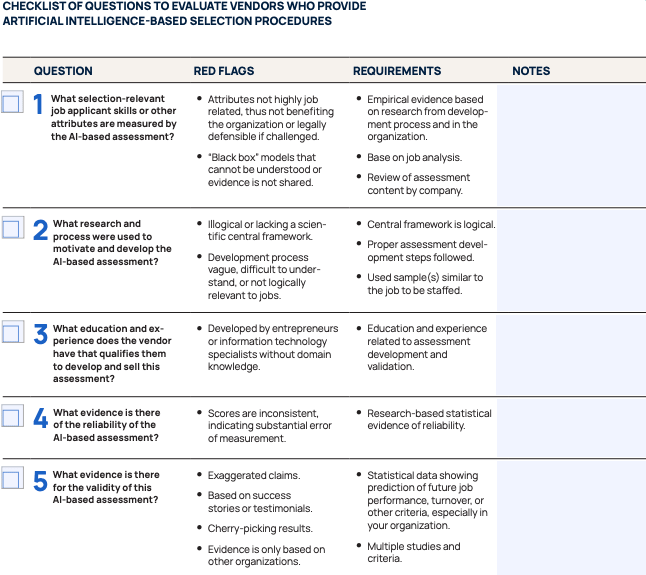
As more AI-based employment tools enter the market, one challenge many HR practitioners face is knowing how to properly evaluate what vendors are actually selling. A new guide from the SIOP Foundation (Society for Industrial and Organizational Psychology) and the CHRO Association addresses this directly. The guide makes clear that these purchasing decisions deserve rigorous and ongoing evaluation, not a one-time review. The guide provides 13 questions that move organizations beyond vendor claims and peer benchmarking toward a more rigorous assessment of AI-enabled employment tools. One example: the guide asks how the tool was developed and whether the validation sample reflects actual job contexts, not convenience samples pulled from paid online survey panels with no connection to real hiring situations, which is a specific red flag the guide calls out. While the questions are primarily focused on employee selection, they can also be applied more broadly when AI is being considered for other areas of HR. Whether you are evaluating AI-based platforms you are considering for purchase or auditing the ones you currently have in place, these questions provide a practical level of rigor that helps make better investment decisions that tap the benefits of these tools while mitigating the risks.

ADVANCING TALENT INITIATIVES
I share two of my slides using workforce planning as an example to show how pairing a clear business case with a practical phased implementation plan can help move talent work into action.
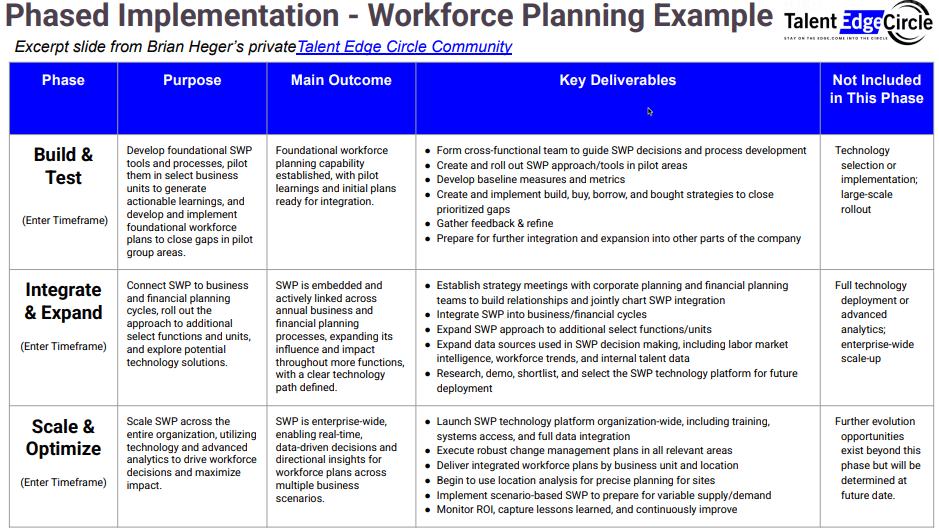
I recently shared the 2026 Creating People Advantage report by BCG and WFPMA , which assessed 28 people and talent practices ranging from workforce planning and succession planning to performance management. Drawing on input from more than 7,000 HR and business leaders, the report examined the gap between future importance and current capability across those practices. Workforce planning ranked #4 among the largest gaps. One reason I believe gaps like this persist across HR is that it can be easy to delay action while waiting for the perfect plan, perfect data, perfect technology, or perfect conditions before getting started. When that happens, the gap is likely to widen and opportunities to accelerate business strategy execution and create stakeholder value through HR may be missed. One way to break that pattern is to pair a clear one-page business case with a second one-pager showing a practical phased implementation plan. I am sharing both using workforce planning as the example. Regardless of the talent work or initiative you are trying to move forward, use these resources to organize your thinking, identify next steps, and build momentum toward action. These are the types of practical topics and tactics we discuss in Talent Edge Circle, my private community for internal HR practitioners.

SKILLS-BASED TALENT PRACTICES
A new article based on an analysis of 87 organizations and more than 28 skills strategies shows why skills-based talent practices create the most value when anchored in specific business outcomes.

As HR leaders and their teams continue moving toward skills-based talent practices, this new Deloitte Insights article offers a useful reset on what actually creates value. Based on an analysis of 87 organizations using more than 28 skills strategies, the research finds that organizations creating measurable value from skills-based approaches start by defining a specific business outcome rather than by building a comprehensive skills infrastructure. Four common outcomes include becoming an employer of choice, improving productivity, building agility, and driving innovation. Once the outcome is identified, organizations can apply a targeted set of skills practices to support it, since different practices disproportionately influence specific outcomes. For example, organizations pursuing the employer-of-choice outcome prioritize internal talent marketplaces and self-reported skills, those focused on agility invest in validated assessments and skill-to-job mapping, and those aiming for innovation lean into skills-based workforce planning. These insights can help HR teams anchor skills-based practices in the business outcomes they are intended to influence.

TALENT IN CRITICAL ROLES
A few of my slides to help leaders evaluate whether their organization’s top talent is occupying its most critical roles.

I have shared many of my resources to help leaders identify their most critical roles. But identification alone isn't enough. Critical role identification matters to the extent that it informs talent decisions that advance organizational performance. And one of those decisions is ensuring that top talent is deployed in your most critical roles. The rationale is that, since these roles disproportionately impact business outcomes, deploying top talent in them can provide a performance advantage. To help determine if your critical roles are filled by top talent, here are a few of my slides excerpted from my private community, Talent Edge Circle. Each slide highlights one area with a primary question, why it matters, probing questions to dive deeper, and indicators to consider. One example is the internal benchmarking factor, which asks: Could someone inside the organization realistically perform this role significantly better in the near future? Why it matters: helps determine if higher-potential talent exists internally and whether the incumbent is the best fit. Probing questions: Are we keeping this person in the role due to familiarity rather than capability? Indicators to watch out for: internal employees in similar roles are outperforming the incumbent, and high-potential talent is being underutilized. Use this resource as a starting point and modify it to reflect your organization's context as you work to ensure your best talent is in your highest-impact roles.

SUCCESSION PLANNING
My cheat sheet that helps HR practitioners evaluate whether to use role-based succession, pool-based succession, or a combination of both based on their organization's context.

One design decision many practitioners consider when implementing succession planning is whether to plan by specific role or talent pool. With role-based succession, you identify people as successors for a specific role. With pool-based succession, you develop people around shared capabilities that apply across multiple roles. Neither approach is automatically better; it depends on what your organization needs and how it operates. In many cases, the answer is both. Consider a retail organization with hundreds of store General Manager roles. For broader store operations, a pool-based approach may make more sense, since managing a separate plan for each similar role may not be realistic. However, for flagship locations with larger P&L responsibility, brand visibility, or strategic importance, a role-specific plan may be more appropriate. To help practitioners think through this decision, I’ve created a one-page cheat sheet to stimulate ideas. Since succession planning is as much art as science, the cheat sheet serves as a starting point, not a prescribed formula, to spark discussions that help determine the mix of approaches that best enables effective planning within your specific business context. As a bonus, here is my cheat sheet with to help you think through four areas of SP: succession questions, metrics, development role audit, and triggers to evaluate SP.

SUCCESSION PLANNING
My cheat sheet with with eight succession scenarios, each requiring distinct talent actions to keep plans current, relevant, and actionable.
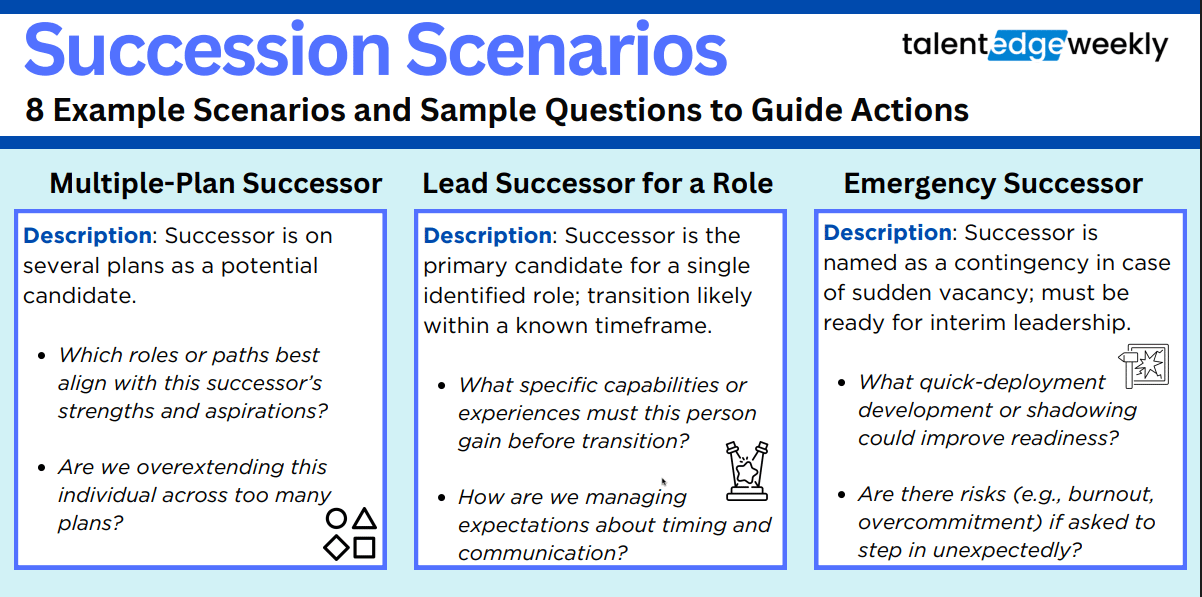
One challenge with succession planning is that after initial successors are identified, different situations often emerge that require adjustments to the original plan. Without ongoing attention, succession plans risk becoming little more than “names on a page” that don’t reflect current reality. What’s needed instead is continuous succession management, where successors are actively developed, reassessed, and supported as circumstances evolve. Here’s my one-page cheat sheet that helps you think through eight succession scenarios that may exist in an organization at any given time. Each scenario is unique and may call for different talent actions informed by the right questions. For a Ready-Now Successor in Waiting (fully ready, but there is a low likelihood the incumbent will vacate the role in the near future), a question to consider is: What is the retention risk if advancement remains delayed? If it is high, what can be done to reduce it? For Declining Successor Readiness (readiness has plateaued or regressed due to performance, engagement, or context changes), ask: What factors contributed to the decline—skill gaps, motivation, or external shifts? Is the role still the right fit, or should we redirect the successor to another opportunity? Questions like this can help prompt ongoing actions rather than waiting until formal succession planning cycles to address them.

INTERNAL MOBILITY
I share three of my internal mobility cheat sheets to help HR practitioners identify IM gaps, measure progress, and remove barriers.

Internal mobility (IM) is rising on the talent agenda as organizations prioritize developing and deploying talent from within. LinkedIn's 2025 LinkedIn Workplace Learning Report finds that even among organizations without mature career development and IM programs, 48% say IM is a higher priority this year. Yet despite this renewed focus, many organizations struggle to move from IM intent to IM execution. To help bridge this gap, here are three of my resources that address different and complementary aspects of IM. The first is my IM Diagnostic, a one-page tool with 20 statements across 10 key areas, such as transparency, manager support, and policy design, to help identify where your organization's IM efforts may be falling short. The second is my IM Metrics cheat sheet, which includes nine example metrics with definitions, rationale, and sample practices to help measure the impact of IM investments. The third is my Barriers to IM cheat sheet, which examines specific policies and non-tech factors, such as restrictive tenure rules and manager resistance, that can hinder talent movement even when organizations have the right intentions. If internal mobility is a focus of yours, this is one of the topics we dive deeper into in my private community for internal HR practitioners, Talent Edge Circle.

ENGAGEMENT AND RETENTION
A new HBR article draws on research published in Organization Science to show how managers often overload their most motivated employees, quietly hurting retention.

I recently shared my post and one-page cheat sheet on goal creep, when new goals are added mid-cycle without recalibrating current priorities or resources. The core point was that when new work is added without adjusting current priorities or available capacity, teams can end up with competing demands that put all objectives at risk. A new Harvard Business Review article from Cornell and Northeastern researchers adds another reason this matters. Drawing from their study just published in Organization Science, the authors highlight how managers often give additional work to employees they see as highly motivated, assuming those employees will welcome it and be less likely to burn out. But that assumption can be wrong. Over time, consistently giving extra work to the most motivated employees can reduce job satisfaction and increase the risk of turnover. My challenge is for both managers and employees to be more intentional: managers about what they assign, and employees about what they agree to take on. Whether the issue is goal creep or workload distribution, my one-page cheat sheet includes six questions to help teams decide whether new work should be taken on, what needs to shift to make room for it, and how it will be resourced.
II. AI IN THE WORKPLACE
Covers how AI is transforming organizations and reshaping jobs, examining what separates successful enterprise AI deployments from failures, AI's impact on early-career roles, how AI is influencing employee engagement and the global workplace, and how organizations should approach work redesign in an AI era.

AI DEPLOYMENT
A new 116-page report that draws insights from enterprise AI deployments to identify what separates success from failure.
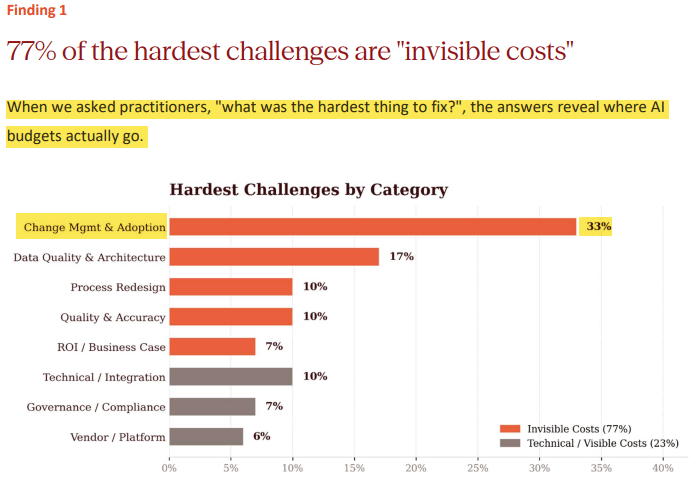
There are many reports and papers on how AI will impact work. But one type of resource that I find especially helpful is hearing from organizations that have deployed AI at scale, the lessons they learned, and guidance for others considering similar efforts. With that as the backdrop, this new 116-page playbook from Stanford's Digital Economy Lab shares practical insights from 51 AI deployments. While there are too many insights to summarize here, one common theme is that an AI deployment’s success or failure was not about the technology, but rather the organization’s readiness, its processes, and its willingness to iterate. One recruiting case study on page 25 illustrates how an AI-enabled recruiting effort failed because leaders assumed AI would fix broken processes. However, the second effort succeeded because the CEO took direct ownership, the process was fixed before applying AI, and the effort stayed focused on the business problem the organization was trying to solve. The results included an 83% improvement in candidate intake efficiency and a 75% improvement in candidate conversion. The playbook also includes cases in customer support, sales, supply chain, clinical care, and more. To reinforce the value of starting with the business problem or opportunity in any HR-supported effort, I am resharing my one-page cheat sheet on the topic.

AI AND SKILLS
A new 21-page report examining how AI will reshape jobs using a 6-category framework, with implications for talent strategy.
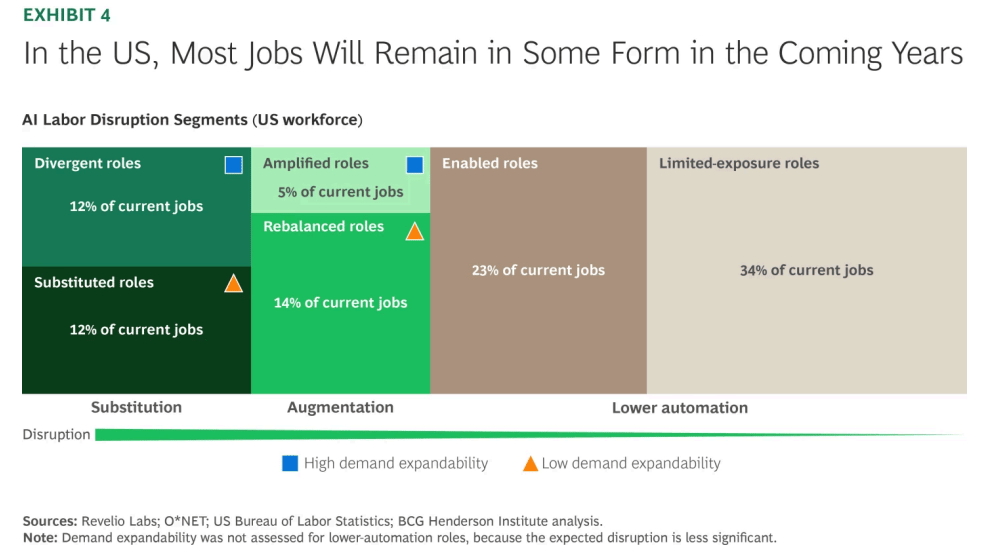
This new 21-page BCG Henderson Institute report shares insights from an analysis of approximately 165 million U.S. jobs, finding that 50% to 55% will be substantially changed by AI over the next two to three years. Rather than predicting broad job losses, the report organizes roles into six categories, including Divergent Roles (12%), where AI takes on more structured work while senior roles grow and junior roles shrink; Substituted Roles (12%), where AI handles more core work directly and fewer people are needed; and Rebalanced Roles (14%), where work shifts toward higher-value activities. For HR practitioners, these findings can help think through implications across several areas of talent strategy. In workforce planning, this can help identify where role redesign, redeployment, succession depth, and headcount shifts may be needed. In talent acquisition, it can help leaders adjust hiring plans and protect early-career pathways that build future talent pipelines. In talent development, it highlights where ongoing reskilling and upskilling may be most urgent as work changes within roles. These are just a few of the implications. I encourage you to read the full report, review each of the six role categories, and consider what they may mean for talent strategy and the underlying HR and talent practices that enable it.

AI TRANSFORMATION
A new article distills 12 themes that separate companies that are transforming their business with tech and AI from those that are not, drawing from hundreds of large-scale transformations.

As HR practitioners help leaders think through what increases the likelihood of AI transformations succeeding, this new McKinsey article outlines 12 themes separating organizations innovating with AI from those running experiments that never scale. For each theme, it includes a diagnostic question leaders can use to evaluate their efforts. Three themes include: Theme 1: Enduring capabilities over one-off solutions. This helps leaders assess whether they are building repeatable capabilities rather than isolated wins. Diagnostic question: Are you building enduring capabilities for the journey, or merely delivering one-off solutions? Theme 3: If the value you’re creating doesn’t move the business, you’re getting it wrong. This helps leaders assess whether AI efforts are tied to business impact or just incremental gains. Diagnostic question: Will our business transformation plan result in game-changing value, or will the wins be incremental? Theme 9: Design for adoption and build for scale. This helps leaders consider whether the organization can embed and scale AI beyond isolated efforts. Diagnostic question: Can your organization repeatedly adopt and scale AI, or is it still relying on isolated heroics? Together, these themes and diagnostic questions can help HR practitioners guide leaders on where AI investments are most likely to create long-term business value.

STATE OF AI
A new 400+ page report that provides the most comprehensive annual AI state-of-the-field report. I hone in on one finding related to early-career roles.
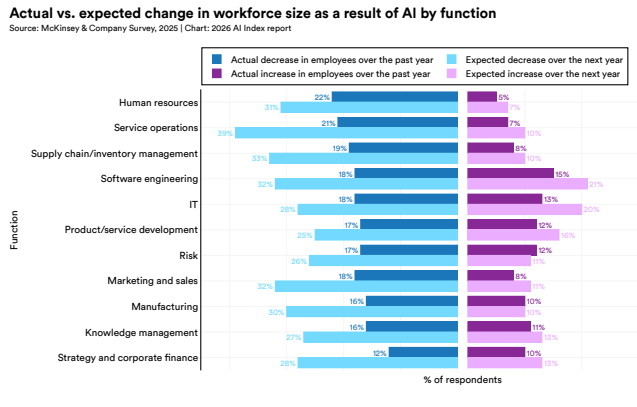
As HR practitioners navigate the many implications of AI for the workplace and the future of work, this newly released report by Stanford's Institute for Human-Centered AI provides one of the most comprehensive independent reviews of AI's trajectory available. While there is much to unpack in this 400+ page report, one topic I want to expand on is AI's impact on early-career employment and what this means for future leadership pipelines. One finding is that early-career workers in AI-exposed roles such as software development and customer support have experienced meaningful employment declines, while mid-career and senior workers in those same roles have held steady or grown. This is an important finding, given that entry-level roles help people build tacit knowledge, judgment, and the leadership capability that senior roles eventually require. Organizations that automate away entry-level positions without rethinking early-career talent strategies are likely to find their leadership pipelines weakening in the years to come. A few weeks back, I pointed out how IBM is taking a different approach, announcing plans to triple its U.S. entry-level hiring in 2026 and redesign junior roles around judgment, oversight, and customer engagement rather than routine tasks that AI now handles. Reflection: How is AI changing early-career roles in your organization? Do you have a strategy for redefining them before the pipeline gap shows up in your leadership bench?

EMPLOYEE EXPERIENCE AND AI
Gallup’s new 2026 edition of its annual global workplace report offers insights on various aspects of employee sentiment and engagement.
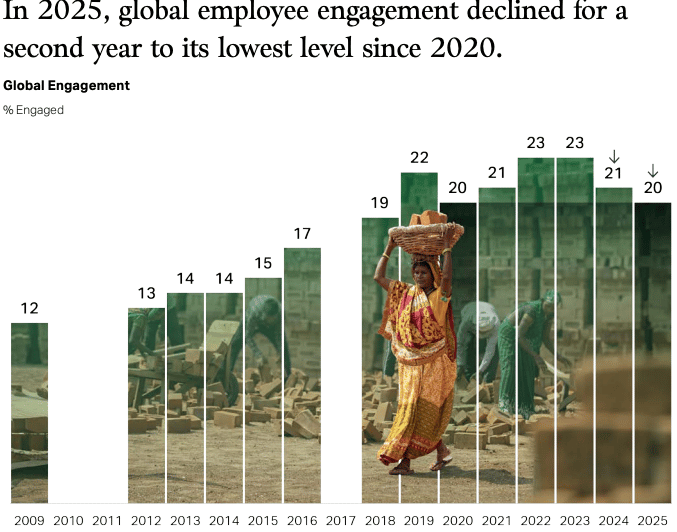
With employee experience being a central focus for many organizations and leaders, the newly released 2026 edition of Gallup’s annual State of the Global Workplace report offers useful insights into employee sentiment. While there are several insights throughout the 251-page report, one notable finding is that manager disengagement is the primary driver behind the 20% drop in employee engagement from its 2023 peak. Manager engagement has declined at nearly three times the rate of employee engagement over the past three years, a shift from the past when managers typically reported higher engagement than individual contributors, whose engagement has remained relatively flat. A second key finding is that managers are also the strongest predictor of AI adoption success in the workplace, even more than technical integration. Employees whose managers actively support AI use are 8.7 times more likely to say their work has been transformed by AI. For HR and talent leaders, one implication is that rebuilding manager engagement is not a separate initiative from driving AI impact, but rather part of the same initiative. Said differently, there are implications for how organizations design AI change management and enablement programs. The report also includes additional insights, including regional breakdowns showing how workplace sentiment varies across geographies.

WORK REDESIGN & AI
A 20-page paper focused on how work redesign in an AI era should start not with the technology, but with one question: what work actually needs to be done?
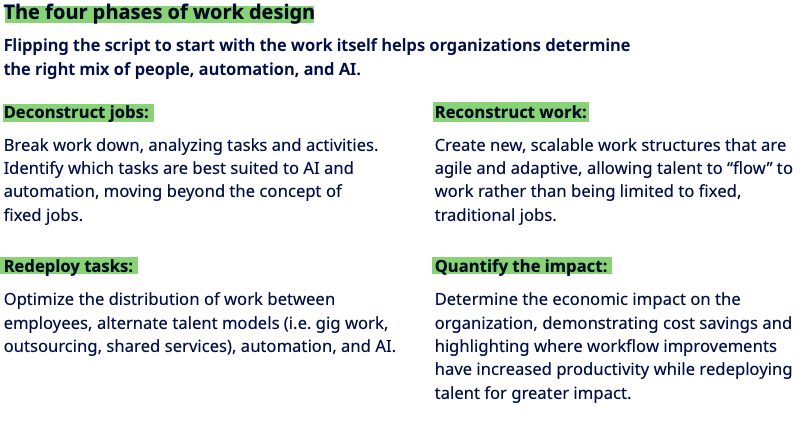
As organizations invest in AI, they must think carefully about how work should be structured, which tasks are best handled by humans, which by technology, which through a combination of both, and how jobs and workflows may need to change. This Mercer paper (a chapter from its 2026 Global Talent Trends report) makes the case that rather than asking how AI and tech can be applied to existing jobs and processes, leaders should start with a more fundamental question: what work actually needs to be done? Mercer then outlines a four-part process: 1) deconstruct work into tasks, 2) redeploy those tasks across people, AI, and automation, 3) reconstruct work into more agile structures, and 4) quantify the impact. One case study illustrates this approach: a global financial services company redesigned a high-impact customer process, with 68 tasks automated, 17 shifted from senior managers to junior employees supported by generative AI, 29 analytical tasks moved to a global capability center, and 14 senior-level tasks being augmented with AI. The distinction matters: when you start with AI or technology, you optimize existing work; when you start with the work itself, you reimagine it. If you're part of Talent Edge Circle, my private community for HR practitioners, you can access our replay and discussion notes from our conversation with Ravin Jesuthasan — futurist and Global Transformation Leader at Mercer and co-author of The Skills-Powered Organization, where we dove deeper into this topic.
JOB CUTS TRACKER
Here is my tracker, which includes announcements from a segment of organizations that have announced job cuts and layoffs since the start of 2023.
A few announcements from April:
7-Eleven (OTCMKTS: SVNDY). The convenience retailer confirmed an undisclosed number of layoffs across multiple departments — including leadership roles — as part of a company-wide reorganization tied to its broader transformation plan. The restructuring accompanies separate plans to close 645 North American locations in fiscal 2026 and convert thousands of company-operated stores to franchise or wholesale operations.
Disney (NYSE: DIS). The media and entertainment giant is planning to lay off up to 1,000 employees, primarily in its marketing department. The cuts follow a consolidation of Disney's marketing operations across film, TV, streaming, and experiences under a single leadership structure, with layoffs expected to begin the week of April 14.
Microsoft (NASDAQ: MSFT). The technology company announced its first-ever voluntary retirement program, offering buyout packages to approximately 8,750 U.S. employees — about 7% of its domestic workforce — whose combined age and years of service total 70 or more. Eligible employees at the senior director level and below will be notified on May 7 and will have 30 days to decide whether to accept.
Nike (NYSE: NKE). The sportswear company announced approximately 1,400 layoffs concentrated in its global operations division, with the majority in technology, affecting employees across North America, Asia, and Europe. The cuts represent less than 2% of Nike's total global workforce and are part of the company's "Win Now" turnaround strategy, which includes consolidating technology operations into two primary hubs as well as integrating its materials supply chain into its footwear and apparel teams.
Snap (NYSE: SNAP). The social media company that owns Snapchat is laying off approximately 1,000 employees, or 16% of its global workforce, as it pivots toward profitable growth. CEO Evan Spiegel cited rapid advances in AI that are enabling smaller teams to do more, with the cuts expected to reduce the company's annualized cost base by more than $500 million by the second half of 2026.
CHIEF HR OFFICER MOVES
In April, I tracked 64 hires, promotions, and resignations in the Chief HR Officer (CHRO) role through CHROs on the Go, my subscription-based digital platform that monitors movement in the CHRO role.
A few headlines from April:
The Coca-Cola Company (ATLANTA, GEORGIA) [NYSE: KO] — a global total beverage company — announced that Tapaswee Chandele will become Global Chief People Officer, effective May 1, 2026, succeeding Lisa Chang, who is stepping down after a seven-year tenure. Chang will remain with the company through the end of 2026 as a senior advisor and will serve on the board of The Coca-Cola Foundation. Chandele, a 25-year Coca-Cola veteran, most recently served as SVP Chief of Staff to President and CFO John Murphy, a role she held since May 2025. Prior to that, from 2019 to 2025, she served as SVP of Global Talent, Development, and HR System Partnerships. She will report to CEO Henrique Braun.
Comcast (PHILADELPHIA, PA) [NASDAQ: CMCSA] — a global media and technology company — announced the promotion of Vicki Williams to the newly created role of Chief Human Resources Officer, overseeing HR teams and strategy across the company's entire media and cable portfolio, including NBCUniversal and its Connectivity & Platforms business. Williams, who has served as NBCU's head of HR for the past eight years, joined the company in 2011 as SVP of Compensation, Benefits and HR Information Systems.
Intel (SANTA CLARA, CALIFORNIA) [NASDAQ: INTC]— a global semiconductor company that designs and manufactures advanced semiconductors—announced the appointment of Aparna Bawa as EVP and Chief Legal & People Officer, effective May 2026. Bawa joins from Zoom, where she served as Chief Operating Officer, overseeing operational, legal, and people functions during a period of rapid growth and global scale. In her new role, she will lead Intel's global legal, ethics, compliance, people, and culture organizations, reporting directly to CEO Lip-Bu Tan.
XBP Global (IRVING, TEXAS) [NASDAQ: XBP] — a multinational technology and services company — announced the appointment of Acquelia Colaco as Chief HR Officer. Colaco most recently served as Head of Colleague Experience at Tesco Business Solutions. Prior to Tesco, she held senior HR roles at Infosys spanning more than six years. In her new role, Colaco will lead the global people's agenda across the Americas, Europe, and Asia, with a mandate to align talent, leadership, and culture with the company's AI-first transformation strategy across its approximately 10,600 employees in 20 countries.
Join CHROs on the Go to access all detailed 64 announcements from April and +4,500 archived announcements. Monthly + annual subscriptions available.
If you are already a subscriber to CHROs on the Go, log in here.
My Private Community
If you’re an internal HR practitioner who wants to go deeper with me and other internal HR practitioners on talent topics tied to your most critical priorities, learn about my private community, Talent Edge Circle.
🗓️ May 6, Anna Tavis, thought leader and Department Chair, Human Capital Management at New York University, will join Talent Edge Circle for a discussion on how organizations are scaling digital and AI-enabled coaching.
🗓️ June 17, Adam Gibson, Practice Lead for EY’s Org & Workforce Transformation Organization and author of Agile Workforce Planning, will join Talent Edge Circle for a discussion on strategic workforce planning.
🗓️ July 22, Dave Ulrich, professor at the Ross School of Business (University of Michigan) and co-founder of The RBL Group, will join Talent Edge Circle for a discussion on creating stakeholder value through HR.
I look forward to sharing more resources with you throughout May. Have a great month ahead, and I’ll see you in next week’s regular issue!
Talent Edge Weekly is written by Brian Heger, an internal human resources practitioner. You can connect with Brian on LinkedIn and brianheger.com